

What The City Permits
Osric Dyer's Last Case

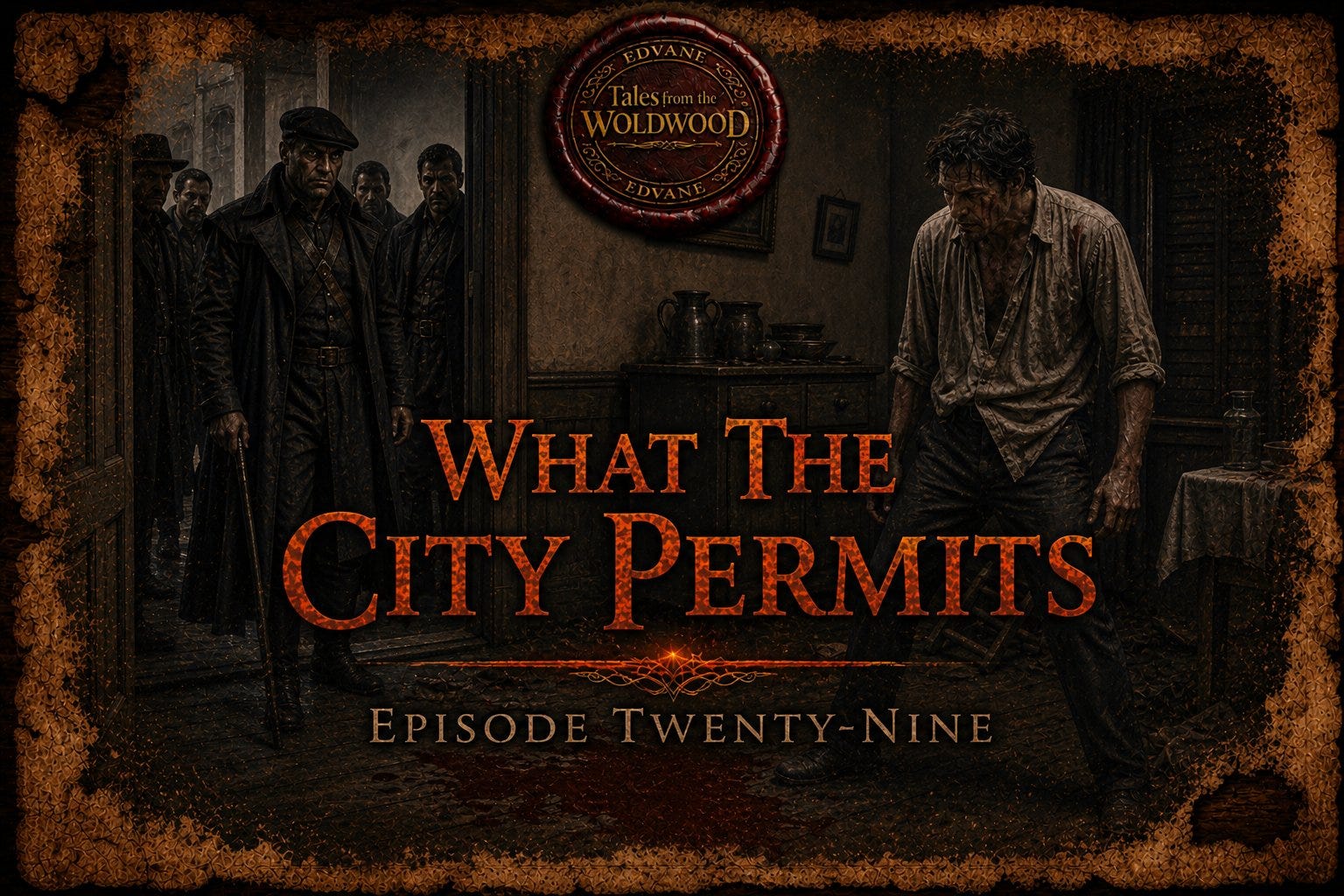
Far to the south of the Woldwood stands the city of Lenth, which prides itself on order. When something went wrong, they named it, fined it, or buried it. One man was always sent to make sure the process held. Until the day he saw it for what it was.
Osric Dyer had learned to judge the city of Lenth by what it tried to hide. He had started as a clerk and had taken the reeve’s cane when his predecessor died suddenly. He was not a beloved man. His job was to ensure the city’s laws remained more than just ink on paper and to keep the panics local and brief. In Lenth, there was a brand of trouble that took money and a brand that took blood. The first came dressed in proper coats and brought petitions, the second came in whispers. Occasionally, they came together.
It was the second kind that had made him most useful to the Aldermen. Lenth loved to pretend it was a rational place, yet too many of its goings-on defied explanation. In the outer wards, there were cellars where a man could pay another man to scratch chalk and pray over a bowl of blood. Osric had never sought such matters. He had only ever been the one sent to stand in doorways and keep the crowd back while someone else sobered up, bled out or confessed. He had seen too many things that would prevent lesser men from sleeping soundly.
The summons arrived at dawn on a day that should have been ordinary. A messenger waited in Osric’s office, holding his cap in both hands and glancing repeatedly at the door. “Alderman Greaves requests you attend at once,” the messenger said. “It concerns a disturbance.”
Osric dipped his pen, finished the sentence he was writing, sanded it, and only then looked up. “ It always does. What kind of disturbance?”
The messenger swallowed. “In Whitehollow Street. A household. They say the noise has not stopped since last night.”
“A brawl?”
The man shook his head. “Not a brawl. Screaming. All night.”
Osric set his pen down. “Who is the householder?”
“Lysander Bly,” the messenger said. “Dock-factor. Handles consignments. He is known to the bench.”
Osric stood and put on his coat. He took his cane and the seal pouch that marked his authority, and called for four men he trusted. As they walked, Lenth unrolled in layers around them. The docks gave way to warehouses and the warehouses to counting houses. The air changed from fish and tar to fabric and dye as he neared Whitehollow Street. People there watched from behind shutters. They had all heard it. Osric heard it too before he saw the house. It was not a single voice making a single sound. It rose and fell, broke and returned, roughened itself on exhaustion and then found new force. The house sat between two others with its door shut and its shutters drawn. A man from the city watch waited on the corner, pale and furious at being posted there. When Osric approached, he touched his forehead in salute.
“No one has gone in,” the watchman said quickly. “Not since midnight. His wife ran out and fell into the gutter. She’s in a neighbour’s kitchen. She won’t speak. The servants fled.”
“Any fire?”
“No.”
“Any sign of drink, frenzy, a visitor?”
The watchman gulped. “The smell, Reeve.”
Osric had already caught it. The scream continued behind the door, hoarser now and punctuated by wet sounds that made his men shudder. He nodded. “Bring more men, back the street off, find the servants.” The watchman moved to follow his new orders, glad for something else to do.
Osric stepped to the door and rapped hard with the silver ferrule of his cane, then stood back and waited for a response. The screaming neither paused nor even acknowledged the sound. He pushed, and the door opened onto a stale wave of heat. His men stayed close behind him. Inside, the passage was narrow, though it looked like any other household of means. That is, except for the trail of dark smears along the floorboards and the thickness of the air. The scream came from the rear, and they moved carefully toward it. Osric’s boots found sticky pools on the floor, and he noted it, refusing to look down for longer than needed. He reached the threshold and stepped into the room.
The table had been shoved aside, and a chair lay broken. A chamber pot had overturned and its contents spread across the boards. In the centre of it, in a pool of darker wetness, a man knelt with his hands braced on the floor, his back bowed, his shoulders jerking, and his shirt hanging in tatters. His skin shone with sweat, and his hair was matted. His head lifted and dropped in spasms. No longer Lysander Bly. A host.
Osric saw the mouth first, stretched wider than it should have been able to, corners torn, and lips split. The teeth showed in a grimace that kept changing shape, and the tongue moved strangely, pressing against the lower teeth, then retreating. His eyes were open, full of terror, yet there was still a man behind them, trapped and forced to watch that which used him. The sound that came next was not a scream. It was speech. “Reeve,” the man hissed, and then corrected himself with a wet click of the jaw. “Osric Dyer.”
Osric felt rising anger. No one in the room had told the man his name, and he had not introduced himself. He took a step back, the heel of his boot skidding in the filth. “Lysander Bly?”
The creature in the man’s body shuddered, then laughed. The laugh came out as a rasping cough, spitting pink foam. The body rocked, and something cracked. The head twisted to the side and was held there until the neck muscles quivered and dragged it back.
“Bly,” it said, “is tired.”
“What happened here?” Osric asked.
The thing pressed its mouth closed. Then the lips parted again, stretched, and more blood ran down the chin. “He invited us,” it said. “Not with his mouth. With his debt.”
Osric’s men fidgeted. One whispered, “Reeve, we should fetch one of the cunning folk.”
“We should fetch a sanctioned binder,” Osric said, keeping his eyes on the body. He did not raise his voice. He never granted them the dignity of drama.
The creature leaned forward on the man’s hands. The arms trembled as if under too much weight. “Sanctioned,” it repeated, and something like amusement crawled into the word. “The bench sent you.”
Osric was somewhat shocked. There was an intelligence here that observed the city’s structures with the same cold familiarity he himself used. This was new and unsettling. “Stand down,” he told his men. “Do not touch it.”
The thing grinned, and the grin tore the mouth further. “Do not touch,” it said. “Good. He breaks.” It pushed the body upright in a motion that made the spine flex and then snap straight. They all heard the vertebrae crack. The man’s knees buckled, then locked, the feet planted too widely. It stood there, swaying, and the scream stopped, replaced by a wet, whistling sound.
Osric felt something turn hard within him as his focus took over. “You will not leave this house,” he said to the thing that wore the man. “You will not harm anyone else.”
The creature’s laughter returned. “I have no legs,” it said. “I have what he has. I have what was offered.”
Osric picked up on the clue. “Who offered?”
The head twisted again. “Men with clean hands,” it said. “Men who count. Men who trade the city’s soul for their own comfort.” He did not ask for names. That was a trap. It would offer names like bait, half true, half poisoned, and Lenth would drown in accusation.
He left his men watching it and stepped back out into the passage, directing one of the watchmen outside to bring Master Alwen Kress. Kress was the licensed binder attached to the bench, a man whose work Osric respected because it was ugly and honest. “Tell him to bring iron, ash, and men who do not faint at blood. No cunning-folk or physics. Not yet.” The watchman ran.
Back inside, the creature was crouching again, the body’s shoulders jerking as if under strain. It spoke without looking up. “He is tired.”
Osric stood at a distance. “You are the one tiring him.”
“It is difficult,” it said. “To be small. To be limited. He is soft. He tears.”
Osric saw its fingers claw at the boards, scraping splinters. “Why speak to me?”
The creature paused and then lifted its head. “Because you are the city’s hand,” it said. “You decide what is contained.”
Osric felt a cold clarity in those words. The demon did not want to flee. It wanted negotiation. It wanted recognition as part of Lenth’s machinery. “Wrong,” he said. “I decide what is cut away.”
The demon’s grin returned. “Cut,” it repeated, and the body shook with a silent, delighted tremor.
Kress arrived within the hour, his assistants behind him carrying bundles. He did not waste words. He stepped into the house, took one look at the floor, at the man’s mouth, at the posture of the body, and let out a grunt of recognition.
“This is not a street summoning,” Kress said to them. “This is a purchase.”
Osric was a little confused. “How?”
Kress glanced at the body. “Through a proxy ritual, most likely. Executed by a hired hand. A debt turned into a hook. Do you know the man?”
“Lysander Bly.”
Kress snorted and nodded to his assistants, who proceeded to lay iron filings in a rough circle around the body. Not a perfect ring, but enough to define the space. They sprinkled ash and also set down a brazier, feeding it with something that stank like burnt hair, and likely was. The creature watched them with mild interest, head bobbing to an unheard rhythm. Kress knelt within reach of the circle and spoke to the creature as if to a hostile witness. “You have no right here, demon.”
It laughed, then gagged on the sound as Bly’s throat spasmed. “Right,” it said. “The city sold. The city signed. Not with ink. With hunger.”
Kress frowned. “You are in a man, you foolish creature”
“A man,” the creature repeated, and the body’s hands spread on the floorboards. “A man who wanted.”
Osric watched Kress’s hands. Steady, stained, and competent. “Can you remove it?”
Kress did not look away from the body. “Yes. But…”
Osric asked for further clarity. “And the man?” Kress’s silence was answer enough.“If he dies, the street will talk.”
“The street will talk whatever we do,” Kress replied. “If the bench wants silence, they should not have permitted this sort of thing to be commissioned within their walls.”
Osric felt a familiar anger rise at the clean distance of those who voted and slept. He looked at the man’s eyes again, registering the silent plea that kept forming behind his disfigured face.
Kress addressed Osric’s concerns directly. “Listen, reeve. If I pull it free, it will leap. It will take the nearest warm body. Your men. Me. You. If I bind it tighter in him, he will last longer, but he will be less himself each hour. There is one sure way.”
Osric was stoic. “Then say it.”
Kress spoke with a bluntness that made it worse. “We collapse the host. We destroy the body so thoroughly that the thing cannot keep purchase. We do it fast. We do it here. We do not let it out.”
The demon, listening, laughed again. “Fast,” it said with delight.
“Do it,” Osric said to Kress, and felt the words scrape his throat. “You have witnesses, and you will do it without cruelty beyond what is required.” Kress nodded.
Osric sent a man to summon Alderman Greaves and any two from the bench willing to stain their boots. Let them see what their sealed votes purchased. Let them smell it. Let them look into a possessed man’s eyes and still call it management. They would not come, of course. He already knew that.
Kress’s assistants stood around the circle, and the brazier’s smoke billowed more heavily. The demon watched, head twisting, mouth hanging open, slack and torn. Kress moved close, placed a hand on Bly’s chest, and spoke a binding phrase. The demon jerked, then snarled, and the snarl came out as a wet, impossible sound, like a pig being slaughtered. Bly’s body convulsed violently, but the assistants held the circle firm. Kress pressed harder, and something inside the chest gave with a sound like cloth tearing. The demon screamed again, this time in outrage, and the host’s mouth split further, blood spilling freely. Kress did not stop. He pressed again, harder, and the host’s chest and ribs collapsed under his palm in a brutal inward snap. The body arched, then shuddered, and Osric heard breath leaving the lungs in a bubbling rush. The demon’s scream changed pitch, rose, broke, returned, then broke again, each time less coherent, each time trapped inside failing flesh. Kress’s other hand moved to the host’s jaw. He twisted sharply. There was a crack that made Osric’s men recoil, but finally the body went slack, and silence filled the room.
The demon tried to move. It did not rise. It did not leap. It did not take anyone. It simply pressed against the air like something trapped under a lid. The brazier smoked heavier. Kress spoke again, and the pressure in the room grew. Osric felt it in his teeth, in his gums and in his ears. At the last, the demon made a sound that had no throat to form it and pushed once more until, with a sudden slackness that felt like a rope had been cut, it vanished.
Kress sat back on his heels, sweat running down his temples. “It is gone,” he said, while one of Osric’s men retched in the corner.
Osric stepped out into the street and drew in cold air, telling the watchman to pull down the house and burn its contents. He also ordered compensation for the adjoining households. The official story would be that there had been a fever causing delirium. The wife and servants would be held in rooms at a nearby inn until they had been questioned, then sent out of the city with coin enough to start anew elsewhere.
It did not take long for the true shape of it to emerge. Before any talk of possession or unlicensed rites, Osric had his clerks pull Bly’s recent accounts, not because he suspected fraud but because money was where most violence began in Lenth. The pattern was not subtle once it was laid flat. Consignments that went missing did so on the same stretches of quay. Losses clustered around the same guild contracts. Profits flowed, quietly and consistently, toward a number of merchants who had grown accustomed to winning disputes without ever standing in the room when judgement was passed.
Bly himself had been useful rather than guilty. His ledgers showed strain, not cunning. He had borrowed to cover shortfalls, signed papers he did not fully understand and leaned on favours that became obligations. The city had been preparing to break him in daylight, to let his reputation rot and his contracts scatter. That would have been enough for most rivals.
But someone, or several, had chosen otherwise. A far crueller destruction.
The work bore all the marks of a task given at arm’s length. A ritualist hired through two intermediaries, paid in coin that never touched a respectable hand, instructed not to summon strength or spectacle but to lay a wasting, something that would hollow a man out and leave him unfit to speak for himself. Madness would have sufficed. Death would have been acceptable. Silence was the only requirement.
Back in his office, Osric wrote a report for the bench, describing the facts without flourish. He named the rival merchants, the hired hand who had performed the summoning and the failures that had allowed it inside the walls. He requested executions.
The bench returned a decision within the day. Fines, confiscations, public penance and exile for the hired hand. Trade must continue. Guilds must not be shaken. The city must not look weak. He read the decision twice and felt a slow disgust rise. This was what had been wearing him down for years. There were demons in cellars, charlatans selling luck, and mystics forming cabals, but power had learned to digest all of that horror and call it order.
That night, he washed his hands until the skin cracked. He scrubbed under his nails. He poured steaming water over his knuckles. The smell of the house did not leave him. When he closed his eyes, he heard the sound poor Lysander Bly had made when his ribs gave way.
Two mornings later, a letter arrived under the seal of the pale stag of Gefroy Castle. Osric broke it with his thumb and read. Lord Wintred Gefroy invited him to take commission as steward over Gefroy lands. He would manage rents and disputes, represent Gefroy’s authority in the forests and bring discipline to outlying towns and villages where petty officials took liberties. The terms were plain. The salary was generous, and the authority granted was broad. He set the letter down. To Osric, it was neither salvation nor honour. It was distance, and in that moment, distance held the welcome prospect of relief.
He went to the Guildhall one last time and addressed the Aldermen sitting in their fur-trimmed coats, speaking of tariffs, of street repairs, and of Lenth as if it were a machine whose parts could be replaced without cost. He understood that he could remain and become like them, remain and be crushed by them, or leave. He resigned right there, offering no explanation beyond fatigue and the desire for quieter service. The Aldermen accepted with courteous words and immediate haste, already thinking of his replacement, already smoothing the city’s surface back into place.
On the morning he rode out, Osric passed through Whitehollow Street. The house was gone, a dark gap between the walls. He would not miss this place. He rode north into the Marchlands, toward smaller roads and smaller troubles, telling himself that if ugliness rose there, he could meet it early, crush it, and never let it become respectable.
He did not know whether that belief was wisdom or another kind of self-deception. He only knew he needed air that did not taste of ash and burnt hair, and nights where the screams that woke him belonged to honest nightmares rather than the city’s squalid bargains.
So an honest man learned that cities will fall when they discover how to live alongside evil and call the result order.
