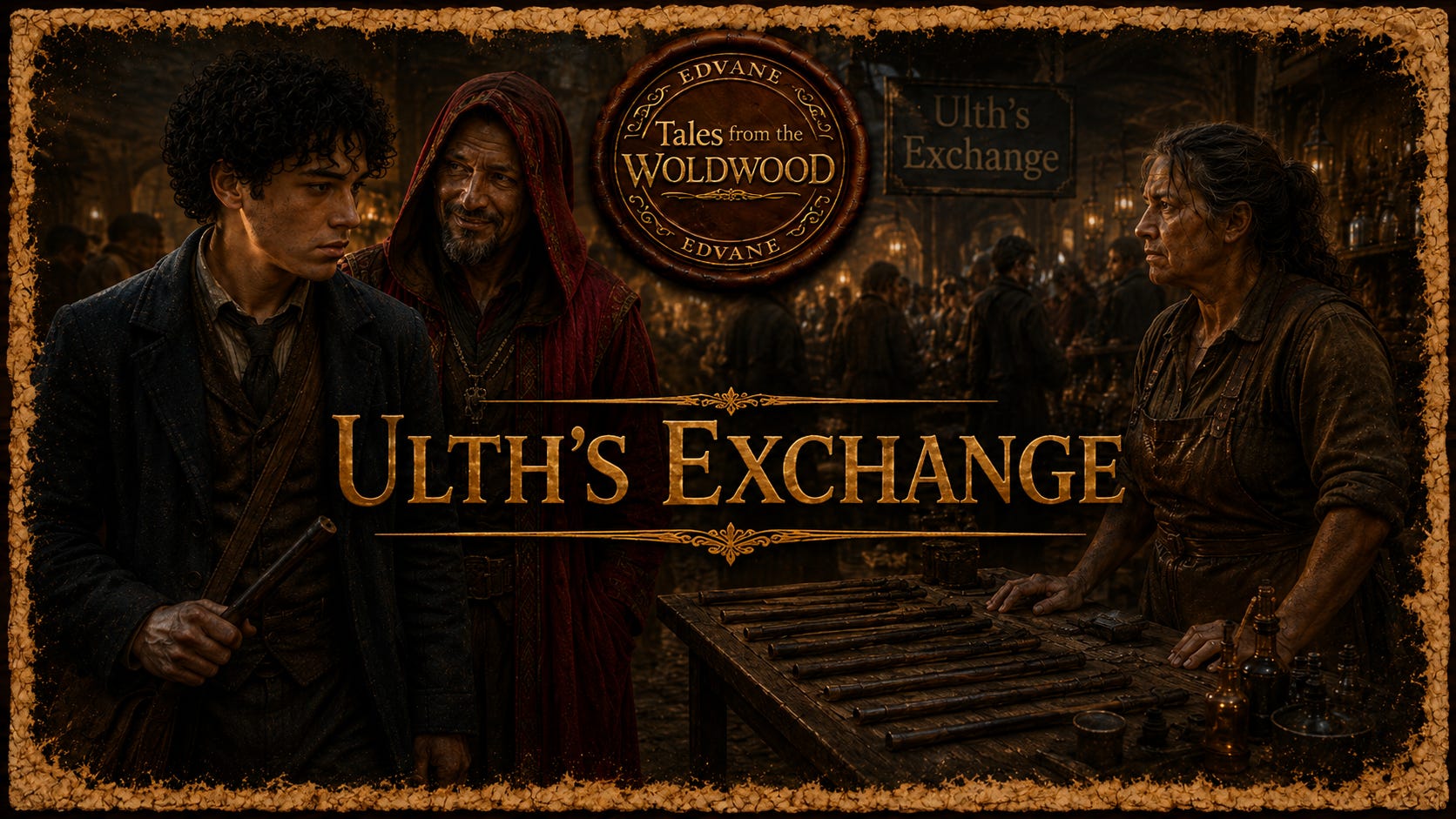
Ulth's Exchange
On wand-shells and choosing...

Today, an account from a Pirrus Master of Elk Ridge. Beneath a forgotten shop lies a market where magic is bought, sold, and misunderstood. Visiting is her apprentice, sent to make a decision his teachers would rather avoid.
Shak Mallory reached Pryth with the day already up and moving. He had read his master’s instructions until he could hear them in his sleep, and still they did not comfort him.
Dark wood.
A small warmth when you touch it.
No embellishments or carving.
Elk Ridge would have chosen for him, if he had been chosen in the way Elk Ridge preferred. Shak had been sent by family insistence and tolerated by aptitude, which meant he was now in Pryth, being asked to do what apprentices were not meant to do. Secure your own beginning; do it correctly, and return with something that does not embarrass you or shame the school.
Ulth’s Exchange sat in a lane that looked no different from the rest. The frontage was narrow, the sign faded, and the window clouded. It was the sort of place you would pass without noticing unless you had been told to look. Shak stopped across from it and watched, waiting for some outward sign of what he had heard whispered about for years. Nothing moved, and nobody went in or out.
He crossed and pushed the brass handle. The door opened easily.
Inside was apparent emptiness. Dust lay thick on the counter and the floorboards. The shelves were bare. A ledger sat alone with its cover curled at the corners. The place only offered damp and long disuse. Shak closed the door behind him, suddenly aware of how foolish he looked, standing in a dead shop with a letter sealed for another man’s eyes. He took the letter from his satchel, laid it on the counter, and spoke the name.
“Ulth.”
Instantly the room became occupied, and Ulth was there, before him, leaning against the far wall where there had been nothing before. He wore a bright red robe with a hood, the colour so clean it looked like it had no right to exist in this grey, dust-drowned space. He eyed Shak with some suspicion before pushing off the wall and moving to the counter. He picked up the letter, pressed the wax seal with his thumb, and the paper opened. Ulth read it quickly, then looked up again.
“So. Elk Ridge,” he said. “They still send their youngsters with ink and insist it should stand in for their judgement then.”
Shak felt shamed. “I’m here for a wand-shell,” he said.
Ulth nodded. “A shell,” he repeated, and it landed like a verdict. “So they’ve sent you to buy what they would rather have chosen. One has to wonder why.”
“My master gave me criteria,” Shak said.
Ulth folded the letter and set it down. “Your master gave you a reference,” he replied. “That is what matters here.”
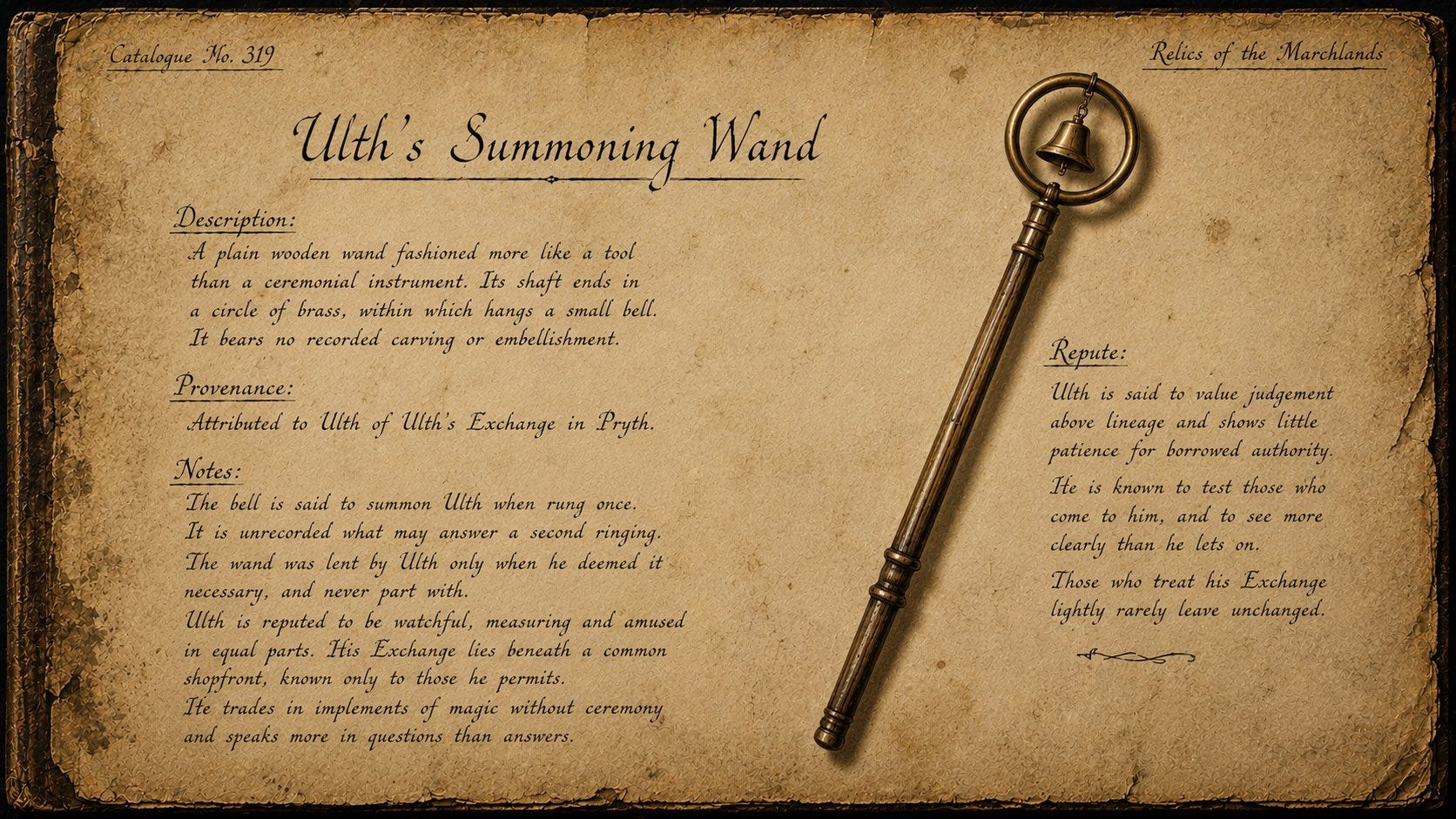
He reached beneath the robe and drew out a wand that did not match his bright theatrics at all. Plain wood. A handle and hilt like a tool. The shaft ended in a circle of brass with a small bell suspended inside it. Ulth placed it on the counter in front of Shak.
“Borrow this,” he said.
Shak stared at it. “Why?”
“Because you’re nervous and you will try to hide it until someone uses it against you. Ring once if you need me.”
“And if I ring it twice?” Shak asked, before he could stop himself.
Ulth’s smile appeared, quick as a cut. “Then you’ll get whoever else is listening.”
Shak took the so-called wand, feeling the plain wood beneath his fingers. It was not a wand. It was made of wood, not bone. The bell swung faintly, and a dull note sounded.
“Come,” Ulth said.
He walked to the back wall between two empty shelves and pressed his palm flat against the wood. It yielded under his hand, and air spilled through that smelled like bodies, hot lamps and oil. Ulth stepped through. Shak followed and was immediately hit by noise.
The marketplace below was vast. Lamps hung overhead and threw smoky light across crowded aisles. The stalls ran in rough lines, tables piled with goods that ranged from the mundane to the dangerous. Voices overlapped constantly as vendors shouted prices. Customers argued back, and someone laughed loudly while another swore. There was neither hush nor reverent restraint. Magic was present, but it was handled like any other trade because who there would notice the difference?
Ulth moved ahead, the crowd accommodating him without ever stepping aside in deference. He did not push or shove. He just arrived where he meant to be. Shak stayed close, one hand on his satchel strap, the other wrapped around the summoning wand.
“You know the difference between shell and wand?” Ulth asked as they walked.
“Yes,” Shak replied.
“Say it,” Ulth said.
Shak felt nervous. “A shell is the first form,” he said. “The structure that becomes bone. The wand grows from it.”
Ulth nodded. “And the wrong shell gives you the wrong wand. Sometimes useless. Sometimes worse than useless.”
They reached a junction where the aisles met, and Ulth stopped, causing Shak to halt abruptly and see Ulth looking at his face as though seeing him clearly for the first time. “You will be offered what you want,” Ulth said. “You will be offered what you think you want. You will be offered what makes you feel less afraid. Your job today is to choose what suits your path, not your anxiety.”
Shak turned the remarks over in his mind. “Will you be with me?” he asked.
Ulth’s smile returned. “Not always,” he said. “Ring once if you must. Do not ring for comfort.”
Then Ulth was gone. There was no dramatic exit. He just wasn’t beside Shak any more. Shak took two steps after him and met only bodies and noise. The red robe had vanished into the crowd. Shak stood still long enough to feel a little panic try to grip him, but forced himself forward. He had come there on a reference and a list, not on Ulth’s hand.
He moved down an aisle where the noise was louder. People brushed him constantly because there was no room not to. Someone shoved past him muttering a curse, while a vendor shouted something obscene at a rival and got a roar of laughter in response. Shak tried to keep his mind on his purpose, but his eyes kept snagging on everything at once, the living proof that the world of magic was not a clean hierarchy of schools and approved practices. It was a marketplace, and very human.
He found the first shell seller by the simplest sign of all: a man shouting the word as if it could force customers to materialise. “Shells!” the man bellowed. “Wand-shells, clean and true, no rot, no tricks!”
Shak stepped up to the stall. Wooden boxes were stacked behind it, and lengths of dark wood lay on a scarred table. The vendor was broad and red-faced, eyes alert, sleeves rolled, and terminally impatient. “What do you need, lad?” the man barked.
Shak kept his voice steady. “A wand-shell. Dark wood. Slight warmth. No carving.”
The vendor’s grin widened. “Ha. Elk Ridge fodder,” he said, and others close by looked at Shak and laughed, knowingly. He reached into a box and slapped a wand-shell down on the table, glossy black, squared at the ends like a piece cut for furniture. “There,” he said. “Dark. Warm. Plain. Ten crowns.”
Shak picked it up. It warmed quickly, too quickly, as though it had recently been held near a flame. The surface was unnaturally smooth, and its sheen looked more like a coating than a finish. He brought it closer and caught the faint scent of resin and oil beneath the smoke and sweat of the market. He looked up. “What was it treated with?”
The vendor’s grin faltered, then hardened. “It was properly finished, sir,” he snapped. “You want raw wood, go pull it off a dead branch.”
Shak set the shell down. “I don’t want it.”
The vendor’s voice rose, drawing attention. “You don’t want it,” he repeated loudly. “You lot never want anything unless your master chooses it for you. Fine by me. Waste your day.”
Shak forced himself not to react. “Thank you,” he said, because Elk Ridge had instilled manners into him before it taught him fire.
He moved back into the crowd knowing he had avoided an easy trap, almost insulting in its bluntness, and he could still feel how it had tried to hurry him. Hurry meant the error of paying for the feeling of having finished. He walked further into the crowds until he saw a wizard in a stiff coat arguing loudly with a vendor, demanding a written guarantee. He heard the vendor laugh and refuse, and the wizard begin threatening him. Nearby, three Falsrotts stood at a metal-and-bone stall, loud and irreverent, mocking the wizard’s insistence on documentation. Shak could tell they were Falsrotts from the blatant augmentations and improvements on display.
One of them shouted, “Get it in writing, lad, so it can betray you properly,” and the others laughed.
Shak felt the noise and the press of bodies grind at his ability to think. His master’s criteria sounded again in his mind. Dark wood, warmth, plain. He had rejected one obvious wrongness, but that did not help him choose the rightness he needed.
He found the second pressure point without looking for it, because it found him. A stall laid out wand-shells on black cloth in tidy rows, tagged with little notes. The vendor was skinny, clean-handed and smiling, quietly deciding Shak would buy.
“You seek a beginning,” the man said.
Shak kept his tone flat. “Wand-shell. Dark wood. Slight warmth. No carving.”
The vendor nodded in approval and held out a shell that looked perfect. Dark, plain, rounded at the ends, grain tight and near invisible. When Shak touched it, it warmed on cue. Was this the one that had been waiting for his hand? This was what part of him wanted. This would look correct, feel correct, and it would stop the fear of returning to Elk Ridge with something questionable. “How much?” he asked.
“For you, five crowns,” the vendor said. “That’s a fair price and an excellent choice. You don’t need to make this harder than it already is.”
Shak thought that last remark a little unusual and examined the wand-shell. It seemed engineered for approval and fit his palm too neatly, showing no resistance and an immediate warmth.
“What is it?” Shak asked.
“Serafall Darkwood,” the vendor said, still smiling. “A favourite in... disciplined hands.”
A favourite. A favourite of whom? Shak could feel the vendor pushing him toward the relief of being done, yet he knew his temptation was not greed. It was assurance. “It feels too ready,” he said, and the words came out like accusation.
The vendor’s smile faded. “You are an apprentice,” he said. “You think difficulty is proof of worth. It isn’t. Take what works. Go back to your school and stop wasting time on uninformed choices.”
Shak set the shell down on the cloth. “No,” he said, a small but firm refusal, and he moved away before the vendor could pull him back with more false words. His heart was pounding, though. He had walked away from a wand-shell that would have soothed his fear. He did not feel particularly proud of it. On the contrary, he felt more exposed by it, like he had refused something he could not justify refusing. He lifted Ulth’s summoning wand half way, and the bell swung lightly, but he stopped.
Ring once if you must. Do not ring for comfort.
Shak closed his eyes for a moment, and could focus only on the market’s noise, scattering his thoughts. He opened his eyes and found Ulth standing beside him again. Shak’s first instinct was to blurt an explanation, as though Ulth were his master and he were a boy caught doing something wrong.
“I didn’t ring,” Shak said.
Ulth glanced at the wand. “I know,” he replied. “You were about to though.”
“I don’t know how to choose,” an admission which had become unavoidable.
“You do,” Ulth said. “You just don’t like what you know and also what you don’t know. You want the choice to make you feel safe, but that isn’t your job today, Shak.”
“Then what is my job?”
Ulth paused. “To suit your path,” he said. “To show you who and what you are when you stop performing for approval. Come.”
Ulth began moving through the crowd, and Shak followed, afraid of losing him again and equally afraid of needing him. Ulth did not speak as they walked. He did not narrate the market. He led Shak as if through a familiar inconvenience. They reached a stall that did not shout for business with no bright display and no tidy tags. Just a long table of dark wood marked by use, with shells laid out in erratic lines. The vendor was a woman with a hard face and old scars that had healed clean, with strong arms and flat eyes.
Ulth nodded once. “Shak, this is Hedda. Hedda, this is Shak, from Elk Ridge.”
Hedda looked at Shak, sighed sharply and then looked back to Ulth. “You’ve brought me another anxious one,” she said.
“He’s buying,” Ulth said. “If he can.”
Ulth stepped away, leaving Shak in front of the table, feeling like he had been pushed into deep water. “Wand-shell,” he said. “Dark wood. Slight warmth. No carving.”
Hedda scratched her chin and squinted. “Who told you that?”
“My master,” Shak replied, “ at Elk Ridge.”
Hedda reached for a wand-shell near the edge of the spread, and held it out.
“Touch this one,” she said.
Shak took it, feeling coolness at first, then a small warmth that rose slowly and settled. The wood was dark and matte, its grain visible in fine lines. There was a knot near one end, which had been smoothed but not erased, and was a clear remnant of what the wood had been before anyone tried to make it suitable. It did not flatter his hand. It just sat in it, heavy and plain.
“It fits your list,” Hedda said. “Does it fit you?”
Shak hesitated. “I don’t know,” he said.
Hedda’s hand came out to take it back. “Then you’re not ready to buy,” she said.
Shak held on to it. “Wait.”
Hedda stopped, her hand still extended. “Why did you hold it?” she asked.
“Because it didn’t try to please me,” Shak said, and as the words left him, he knew they were true. “It didn’t rush to warm. It didn’t feel… made to satisfy me immediately.”
Hedda leaned forward. “And?”
“It feels steady,” Shak said. “It doesn’t feel like it’s hiding anything.”
Hedda withdrew her hand. “Good,” she said. “Now tell me what you’ll do with it.”
Shak swallowed. “I’m Pirrus,” he said. “Not yet anointed. I’ll be working with binding and shaping. Control and containment.”
Hedda nodded. “You’ll be working with failure too,” she said. “The wand within won’t save you from that. It won’t make your casting pretty, and it won’t make you look certain when you aren’t, but it will show you what you do.”
Shak nodded. “That’s what I want,” he said.
Hedda waited a minute, then reached under the table and brought out another shell. This one was darker, smoother, and looked almost polished. She held it out for him. Shak put the plain one down and took it. It warmed much faster, and it felt eager, like it was reaching to assess him.
“That one sells,” Hedda said. “It makes apprentices feel chosen and that the wand will carry them, but it won’t. It will only make their mistakes louder.”
Shak handed it back and took the first shell again, the one with the knot, feeling its small steady warmth settle under his palm. “How much?” he asked.
“Four crowns,” Hedda said.
Shak blinked. “That’s it?”
Hedda laughed. “You want me to charge you extra so that your fear feels justified, boy?”
Shak flushed. “No.”
“If you take it,” she said, “you stop shopping. You stop asking whether someone else has something better that you’re too ignorant to recognise. So take it and accept what you chose happily. Do you understand?”
Shak drew a deep breath. “Yes,” he said.
Hedda nodded once, reached out, and tapped the shell lightly with two fingers to conclude the matter. “Then it’s yours.”
Shak counted out four crowns and placed them on the table, and then slipped the wand-shell into the inner pocket of his cloak.
Ulth returned and looked at Shak, almost with pride. The suspicion that had greeted him above ground was gone, and what remained was a quiet satisfaction that felt impartial.
“You did well,” Ulth said.
“How do you know?”
“Because you stopped trying to buy reassurance,” Ulth replied. “You chose what suits work, not what suits fear.”
The words did not feel like praise in Shak’s ears. They felt more like a door closing. Ulth held out his hand, and Shak returned the summoning wand, which resumed its place beneath Ulth’s red robe.
“You have no further need of this,” Ulth said.
Shak nodded, unsure what to do with himself. The market still roared around them, indifferent to his small victory.
“Go,” Ulth said.
Shak blinked. “Go?”
Ulth nodded toward the aisle. “Leave,” he said. “Before you convince yourself you need to buy something else. You came for one thing. You have it.”
Shak felt the pull to stay, to watch, to learn and to let the Exchange become a story he could tell himself about being part of something larger. He also felt how quickly that pull could become doubt again, and push him toward another purchase made for the wrong reason.
“Thank you,” he said.
“Don’t thank me,” Ulth replied. “Thank your master for giving you a list that forced you to think. Now go.”
Shak turned away and pushed into the crowd, letting it carry him and keeping one hand pressed lightly against the inner pocket of his cloak. The wand-shell warmed under his fingers, a steady presence that would eventually demand work from him. He did not stop to watch the wizard still arguing about guarantees, or the Falsrotts still laughing at him while doing their own trade. He did not stop for anything. He moved through the market, carrying this fragile thing, until he found the door back to the neglected shop. He took one look back and stepped through it.
There he was, back among the dust and the grey, the empty counter and the bare shelves. Shak stood a moment, breathing in the stale air, then opened the front door and stepped back into Pryth. The lane was unchanged. A boy ran past with sticks in his arms as a woman called after him. The village went on, nobody looking at Shak as he left the shop and nobody interested in where he had been.
Shak walked away, not feeling triumphant or chosen, just that he had made a decision he could stand behind without needing anyone to witness it, and that was enough to carry him out of Pryth without once looking back.
Shak Mallory learned that true power begins long before a spell is cast. It begins at the moment you stop choosing what makes you feel safe and start choosing what you can live with.
Tales from the Woldwood is a free 40-story descent into the Marchlands. The forests, ruins, people, monsters, bargains, and histories that shape the world before the first novel arrives