
The Rinn


In this tale, we enter Nythara, a realm where knowledge was released, and safeguards applied too late. Those responsible faced no punishment. They were processed, and those who escaped found a new use in Aurivath.
Station Releaser Narentis came home with the Athenaeum still on him. He shut the door behind him and listened for the small sounds that once meant life was waiting. Lyrentia was at the table with her jars, sorting dried leaves by scent and colour. She looked up when she heard him, and the smile she offered was genuine.
“You’re early,” she said.
“I’m on time,” he replied, then realised his tone was off and tried to remedy it. “Sorry, it ended sooner than expected.”
She watched as he hung his mantle. It made him bigger than he was, and when it came off, he was Narentis again, although lately he seemed to have forgotten it.
“Did you eat?” she asked.
“Not yet.”
“I kept bread back,” she said, and rose. She moved past him, close enough for him to catch her familiar scent.
She set a small plate down, poured him some water, and sat opposite him. The domestic rhythm had always carried them through the lean times, minor illness and weeks when his station work demanded more hours than he had promised. They had always been steady, never fragile.
Narentis tore the bread and chewed. He could feel the texture, but the taste was bland, and he winced as he swallowed.
Lyrentia watched him. “Was it difficult today?”
“It was ordinary,” he said.
“Ordinary can still take something,” she replied. “You come back different each time, Narentis, a little less here.”
He paused and looked up. “I’m here.”
Her hands rested on the table. “Your body is. That isn’t what I meant.”
Irritation came, swift and unjust. “What do you want from me?”
“I want you,” she said. “Not the station releaser. You.”
The words struck him, and he felt that day’s release hall, with the seals loosening and the moment the air heated. He felt the knowledge pushing to be spoken and the relief when his mouth spoke it. Worse than that, he felt the emptiness afterward, the isolating sense of being a thread, cut and left to fray.
“I’m tired,” he said.
“So am I,” she answered. “I’m tired of guessing what version of you will come through the door.”
He pushed the plate away, and the bread sat half-eaten. “Don’t do this now.”
Lyrentia persisted. “Then when?”
He opened his mouth but could find nothing that wouldn’t be an argument, so he stood up. “I need to wash.”
He crossed to the basin in the back room and splashed water on his face. The water was cold, and momentarily loosened him up. He stared at his reflection in the small mirror, admitting to himself that staring back at him was a stranger. He heard Lyrentia moving in the other room, giving him space he did not deserve.
When he returned, she had gathered her jars and the table was clean. “I’m going to the market tomorrow,” she said. “You should come with me. It’s meant to be warm later. We could walk by the river.”
The river had been theirs when they were younger, when he was a minor clerk, and the Athenaeum was an aspiration rather than a hunger. He pictured the water and the light. The image should have anchored him, but it made him feel the absence of the release hall even more.
“I can’t,” he said.
“You don’t know that,” she replied.
Again he answered harshly. “I do.”
Lyrentia looked down at her hands, trying to summon words that would not make him run. “When you were assigned to Nythara, you told me it was an honour. You told me the work was about letting things into the world that deserved to be known.”
“It is.”
“And yet,” she said, “you look right through me, as if I am just another thing to be managed.”
“Stop,” he said.
Lyrentia rose. She went to him and touched his arm. “Narry, I’m not trying to hurt you. I’m trying to reach you.”
He desperately wanted to respond to her touch and to let it be enough. But behind it all, the shameful urge to go back pushed through. He needed to open seals again, and he pulled his arm away.
Her eyes filled, but she did not let the tears fall. “All right,” she said, and the words were a surrender she did not deserve to make. “All right. Rest, then.”
That night he lay awake beside her, and in the dark he could feel the knowledge lodged in his whole body. He whispered fragments into his pillow, quiet enough that she would not wake, and each whisper eased him for a time but then just left him hungrier.
The following morning, he was already dressed when Lyrentia came into the room.
“You’re going then,” she said.
“It’s my station,” he replied.
She stepped closer. “Narentis... ”
“I need to be there.”
“Is that true?” she asked, “or is it need of a different kind?”
He pushed past her toward the door, and she grabbed his wrist. Her grip was not strong. It was desperate. “Please,” she said, and the plea in her voice was for a simple moment of honesty. “Tell me what’s happening to you.”
He looked at her hand on his wrist. If he spoke the truth, he feared it would spread into her. If he did not, he was already losing her.
“I don’t know,” he said. It was the most honest reply he could bear.
“Then let me come with you.”
“No.” The refusal snapped out of him. He saw her recoil, and his guilt surged. “No,” he repeated. “You can’t.”
“Why?” she demanded, and now the hurt became anger. “Because you don’t want me to see what you’ve become?”
The words were too accurate. He pulled his wrist free and left before he said something unforgivable.
The Athenaeum had made this place what it was. Everyone spoke of it with gratitude and perhaps a whiff of fear. It was where sealed knowledge was opened and released into the world in forms that could be spoken, taught, and used.
Those who worked within it were the Rinn. The term was used as naturally as any trade name. A baker’s son might say, my sister’s a Rinn now, and mean only that she had passed the entry examinations and would spend her days with ink on her fingers and dust in her hair. A magistrate might say, consult the Rinn, and mean a civic process as ordinary as summoning surveyors.
Narentis climbed the broad steps with the others, and crossed into the inner courts. When he reached the sealed chambers, that quiet snapped into hunger. In the Hall of Releases, Scribes carried trays of new copies. Archivists returned bundles to the vaults. Indexers clustered near the tables where petitions were sorted. Releasers gathered on benches along the long chamber, all pretending they were only tired. Narentis found his place and sat, hands on his knees. He stared at the stone floor, fighting the impulse to stand and pace. Across the chamber, Station Warden Pelentis raised a hand.
“Attend,” Pelentis said.
The Hall quieted, and Narentis could feel the collective tension of the Rinn.
“Today’s releases proceed under amended interval,” Pelentis continued. “No more than two seals per Releaser. No unsanctioned continuation. Any sign of instability is to be reported immediately.”
A murmur ran along the benches, and Station Warden Pelentis let the sound run its course before lowering his hand. “Your assignments will be distributed within the hour. Remain seated. Remain calm.”
Remain calm. Narentis kept his eyes on the floor until the urge to speak had subsided. Beside him, Station Releaser Melientis put a hand on his shoulder. “You’re pale,” Melientis said, his own eyes ringed with exhaustion. “Did you sleep at all?”
“A little,” Narentis lied.
Melientis nodded. “I see. We’re all lying lately.”
Narentis did not answer. The words inside him were already pushing at the edges of his control. When his assignment came, it was routine. A civic record. A simple set of old trade agreements bound in layered cipher. The sort of thing that used to feel like honest work, and the kind a Releaser could do cleanly and then leave for home with their mind intact. He sat before the seal, hands resting on its stone lip, and inhaled. The first syllables came out smoothly. The seal loosened, unfolded in the air, and the knowledge beneath emerged into the waiting apparatus that would catch and preserve it. Narentis spoke steadily, his voice trained to be a conduit. The moment the last phrase left his tongue, the energy surged as normal and relief hit him with immense force. All of the tension released and his mind aligned so clearly he could have wept. Then the emptiness rushed in, worse than ever before. He stood too quickly, swayed, and caught himself on the edge of the table. Across the Hall, an Indexer watched him with concern.
“You’re pushing,” the Indexer said when Narentis passed him.
“I’m working,” Narentis replied.
By the time he finished his second release, he was already counting the hours until the next day. Two releases followed by an interval like that were going to feel like punishment. He returned to the benches and sat there resisting the urge to mouth fragments of all he had just spoken. He had started doing that in the last season, repeating phrases quietly to himself after a release, chasing the feeling of completion and any lingering remnants of seal energy. When the bell ended the day, the Rinn left in small groups, but Narentis walked home alone. He could not bear the rhythm of another person’s steps beside him, scraping at his nerves.
Lyrentia was at the table when he arrived. She looked up and smiled in a way that warmed him for a second before the hunger returned and burned it away. “You’re late,” she said.
“I was held over,” he replied, crossing the room and pulling at his robe ties. “They extended the interval again.”
Lyrentia stood. “You didn’t eat?”
“I wasn’t hungry.”
“That’s the third night this week.”
He turned to the window, trying to stare the words out of himself. His hands rubbed together at his sides, a small repetitive motion he did not realise he had adopted.
“You’re shaking,” she said.
“It’s nothing.”
“Don’t,” she said, fatigued. “Don’t say that any more. It’s not nothing. You come home, and you’re here, but you’re not.”
“I told you, I’m tired,” he snapped. “I didn’t mean... ”
“You did mean it,” she said. “Because you’re always on edge like this.”
Narentis understood that his wife was not dramatic or prone to exaggeration. That was why he had married her. She made life feel doable, and if she was saying this, it was because she had witnessed it becoming true. He forced himself to sit down while she brought him a bowl of stew and sat opposite him. He lifted the spoon, then stopped. Even the idea of swallowing made him sick.
“You should have chosen a quieter station,” Lyrentia said, trying to be conversational. “Or become an Indexer. Just filing and calm with that, no stress.”
“I’m not calm,” he said. “Releasing is… it’s what I do.”
“I know, but you used to come home and be able to talk about other things. You used to listen when I spoke.”
“I’m listening.”
“No, you’re waiting for me to stop so the room can be quiet again”
He wanted to deny it and say she was wrong, but he just sat there and felt the painful truth of it. Later, when they went to bed, he lay awake once again and watched her sleep. His thoughts circled around the day’s releases, and when sleep finally descended, it was shallow and crowded with noise.
Over the following weeks, the amended intervals became the new way of things. The Rinn adapted outwardly, finding ways to continue. The Athenaeum of Nythara had endured drought, war, plague, political upheaval, and the loss of entire estates beyond the city’s borders. The Athenaeum continued anyway, because it defined identity.
The cost continued at home.
Lyrentia noticed the way Narentis could not bear stillness. He paced while she cooked. He stood at the window and watched the street, looking for something to open. He grew irritated when she paused mid-sentence. One night she woke to find him standing at the table, hands braced against the wood, whispering in a strange rhythm.
“Narry,” she said, sitting up.
He startled violently, knocking a chair sideways. “Don’t,” he said, looking like a man caught stealing.
“Don’t what?” she asked.
“Don’t interrupt,” he said again, then blinked and seemed to hear himself. “I... I wasn’t...”
“You’re not well,” she said.
“I am,” he insisted. “It’s the interval. They’re doing it for safety. It will pass.”
She stared at him, and in the dimness he saw the fear she had been holding back. “You sound like the Athenaeum,” she said. “You sound like a notice on a wall.”
He wanted to laugh, to make her see he was still himself, but he pulled away from her touch and sat down hard in the chair, his hands trembling.
The next day, in the outer courts of the Athenaeum, a group of families stood in the cold and waited. They were not shouting or protesting. They had arrived, faces drawn, holding letters and petitions, asking to be seen. An official met them near the steps, flanked by clerks. The official spoke in calm tones about dedication, civic necessity and measures being taken. The families listened with the same expression Lyrentia wore when she tried to pretend his shaking was temporary. The Rinn watched from the colonnade and did not go out to them. The Athenaeum did not like its work made domestic. It preferred knowledge in controlled forms, not in the messy shape of a wife’s fear. Narentis returned to the Hall and sat on his bench with his hands locked together. He could not stop thinking about the families outside or Lyrentia’s face when she said he sounded like a notice.
Station Warden Pelentis stood before them again that afternoon. “There has been an increase in reported instability,” Pelentis said. “We are implementing a temporary suspension of all releases.”
The Hall fell completely silent as the Rinn absorbed this news. Then the sound began, scattered at first, a choking laugh, a sob, a sudden bark of anger. A Releaser near the front stood up to protest.
“You can’t,” he said, voice cracking. “You can’t do that.”
Pelentis’s face did not change. “It is a protective intervention.”
The first day of suspension was restless but contained. The Rinn moved through the Athenaeum like trapped animals, pacing corridors, clustering near sealed doors and speaking in frantic bursts. A few attempted to bargain with Wardens, offering proposals, restrictions or personal vows. The Wardens held rigidly to the decree. By the second day, the bargaining became compulsion. A Scribe was found in a lesser vault with his hands bleeding from trying to pry at a seal with a metal rod. He had not been trying to steal. He had been trying to open something because his body had decided that opening was survival. By the third day, the Hall was full of agitation that could not be spoken away. The Rinn began to work unsanctioned, slipping into side chambers, attempting “small” openings and all the while insisting they could manage it. A minor seal broke under strain and released a flood of disconnected energy into the air. Those nearest it staggered, and one woman dropped to her knees and began to speak in a voice that was not hers. A Warden attended to her and held her mouth shut until she convulsed and went still. They carried her out in silence. Restraints arrived soon after in the form of chains. Station Wardens and their assistants moved through the Athenaeum in pairs, securing those who were clearly out of control. Some Rinn submitted, but others fought the way drowning men will fight a rescuer.
Narentis lasted four days. On the fourth he woke with blood on his tongue. He had bitten it in his sleep hard enough to tear. The hunger was no longer a mood. It was a physical demand, a sickness that made his limbs jerk and his skin itch.
Lyrentia stirred and blinked at him. “Narry?” He looked at her and saw only the obstacle she had become between him and the act his body believed would save him.
“I need...” he began, then stopped because he could not say what he needed without making it real.
“You need to eat,” she said, reaching for him.
He flinched away. “Don’t touch me.”
The words were out before he could restrain them. “Lyrentia, I... ” But the hunger had surged again, drowning out anything tender. The room felt sealed, the door felt sealed, even her presence felt like a seal. He stood abruptly, robe half on, fingers shaking so hard he could not tie it properly.
“Where are you going?” she asked, panicking now.
Narentis couldn’t answer. He just left while she watched. He did not know whether she followed him to the door because he did not look back.
The outer courts of the Athenaeum were inaccessible now. Guards stood at the gates, hands on batons. Narentis approached with his hood up, and as he did so heard shouting somewhere to his left. Two Rinn were arguing with a guard, and as he pushed one of them back, the Rinn lunged. Others surged forward, and in the brief chaos, Narentis slipped along the side wall and through a narrow service entry he had used years ago when he was still junior. Inside, corridors echoed with frantic footsteps. Voices rose and fell, authority and pleading tangled together. The council was acting, and he knew it.
The Rinn were being slaughtered.
The Athenaeum had become a pressure cooker, and Narentis was inside it with the lid clamped down. If he stayed, he would break something, or worse, he might break himself and take others with him. He certainly would never see Lyrentia again. Instead he fled into the streets, not stopping until the stone gave way to grass and the buildings fell away. He saw other figures ahead, staggering forward. Rinn. Some with hoods thrown back, faces streaked, mouths moving in soundless prayer to seals that were not there. One man was half-carrying a woman whose eyes were unfocused, her lips twitching as if she were still speaking. Narentis slowed only long enough to recognise a face. It was Station Scribe Tacrentis, once meticulous, now wild-eyed. Rinn were struggling and some were dying but they were all heading for The Marker. It would be their only escape, although few considered what they might be escaping to.
The Marker stood at the northern edge of the realm’s authority, a broad structure of pale stone sunk half into the ground. It was not a gate in the common sense because it did not open and close to trade or travel. It was a place where exit was recorded, and almost always denied to all but Realm Sergeants. Most citizens never went there, but this night it was crowded. Rinn filled the outer pavilion in uneven clusters, faces gaunt with exhaustion. Some sat on the ground with their backs to the wall, rocking slightly, while others paced the perimeter, stopping short each time they reached the cordon of guards. Narentis recognised more faces than he wanted to. Station Releaser Halentia stood near the central plinth, and a pair of Indexers argued in furious voices near the stair. A Scribe knelt with her forehead pressed to the stone and her hands clamped over her ears. Above them all, the Marker’s inscriptions glimmered. Narentis had seen those markings countless times in diagrams and instructionals. He had never stood beneath them like this.
Guards ringed the pavilion wearing the livery of civic authority, not the Athenaeum, and their faces were written with fear. They had not been trained for this, being more accustomed to minor disputes, smugglers, or occasional attempted flight by debtors or disgraced officials. Not this.
Narentis moved toward a group of Rinn near the centre, and someone grabbed him.
“Narentis,” Melientis said hoarsely. “You made it.”
“Barely,” Narentis replied.
“What are they saying?” Narentis asked.
Melientis pointed toward the plinth. A civic officer stood there, flanked by two guards, reading from a tablet, determinedly clinging to procedure.
“All exits are suspended pending assessment,” the officer said. “This is not a punitive measure. This is for your protection and the protection of the realm.”
A ripple of disapproval passed through the Rinn. “We’re not criminals, and you’re killing us,” someone called. “We’re sick,” another voice called out. “And you’re sealing the doors.”
The officer tried to remain calm. “Return to your residences. The Athenaeum...”
“Don’t,” Halentia shouted. Her hands now fists. “Don’t say its name like it owns us.”
The Marker hummed. Everyone there knew the boundary itself was active, and most knew the realm was currently tethered to The Shivering Vale. Access was not just restricted. It was prohibited.
“We can’t go back,” the Scribe at the wall cried. “If we go back, we’ll be massacred. It’s happening now. We have to escape.”
A man broke from the crowd and ran for the gate, but he did not get far. A guard shouted, another moved, and the man was hit with a binding baton, its energy released directly to the brain. The man convulsed and collapsed where he was struck. Two others rushed forward to help him, and were driven back at baton-point. Around them, the Rinn were breaking down in different ways, and Narentis knew the truth of it. The Marker was no longer an exit. It was a lid. He looked beyond the guards, past the inner stair, and saw that several Rinn were already edging that way, drawn by the promise of elsewhere. The guards shouted and then a kind of decision cut through the panic.
“They can guard the Marker,” Melientis yelled. “They can’t guard everything.”
A shout went up near the far edge of the pavilion and those that were able charged. The officers shouted orders that tangled over one another, and authority collapsed into noise. Narentis did not think. He moved. Helentia and some others had rifled the fallen guards and taken their access blocks. Only four were needed, and the gate was activated. Rinn began to enter just as a troop of Realm Sergeants arrived to deal with the disruption. Around forty had made it through when one access block was taken out, and the gate began to seal. The last through just made it, while others were severed and heads, torsos, legs, and feet fell in their wake.
The group descended toward a dim light and emerged into cold, pale skies and a disturbing welcome. Black figures emerged from the freezing air ahead, standing at measured distances, each with a face too smooth to be mortal. The first Rinn to reach them collapsed, sobbing, and began to speak rapidly, begging and pleading. The black figure did not respond. It just watched. Another Rinn lunged forward, but his motion slowed and then stopped, suspended in the act. His mouth opened in a soundless scream. His body convulsed once and went limp, collapsing into the snow. Some stared in horror, others in blank fascination.
Narentis’s legs gave out, and he dropped to his knees as one of the Shepherds of Aurivath came closer. The figure’s pale eyes fixed on Narentis with the calm of process. He tried to speak, but the Shepherd raised a hand slightly. It was not benediction or warning. It was measurement. Around him, others were being assessed in the same silent manner. Some were allowed to stumble on, and others were stopped and did not rise again. There was neither cruelty nor mercy in it. It was simply what happened.
The Shepherd turned and moved away. Narentis, still on his knees, found his body obeying. He rose unsteadily and followed. They walked for what felt like an age, and the landscape became stone, then corridors, then stone again. At some point a door opened ahead, and they all passed through. The surviving Rinn were gathered into a chamber and seated, and suddenly an army of Shepherds fell upon them. Narentis tried to think of Lyrentia, and for a moment her face surfaced. He recalled the way she leaned over the table with thread between her teeth, the way she laughed when he used his title at home out of habit and she told him, Narry, you’re not in the Hall now. The last thing he recalled was her touch. The memory came so vividly all he could do was say her name aloud over and over again.
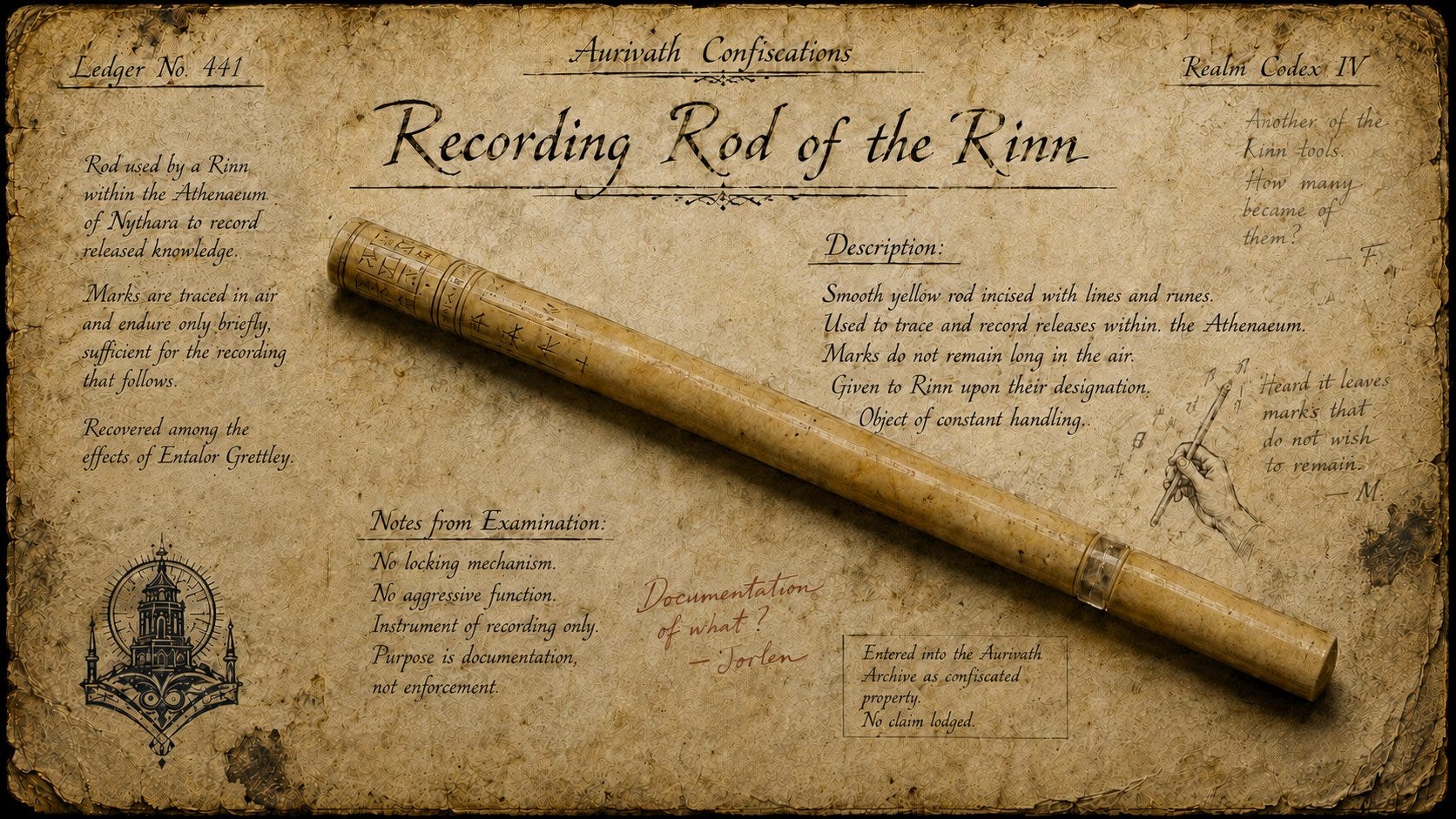
When Narentis woke, he found himself in a larger room where those around him moved like quiet functionaries. Not Shepherds. Their heads were bowed and their hands held thin tools, narrow rods that traced lines in the air, leaving marks that did not like to be seen for long. Narentis stared, his hunger rising again at the sight of marks and of language becoming visible. At that moment one of the figures pressed a rod into his hand. It was Halentia, but she didn’t see him and her face was somehow different, and becoming smoother. He looked down at the rod, and while his hand wanted to grip it like a weapon, his mind wanted to speak with it.
Narentis now knew what had been done. The craving in him had not been cured. It had been harnessed. His need to open and release would be turned into endless recording. No completion or dissemination, only measure and mark. His fingers began to move, slowly at first, then more certain as the compulsion found a path. He traced a line in the air and a mark appeared, hovering momentarily before fading. Across the chamber, the other Rinn worked, murmuring among themselves.
Narentis’s shoulders sagged with a grief that had nowhere to go. There would be no going back and no message sent. There would be no closure offered by any authority, and somewhere beyond those walls, a woman would wake and find her home intact and her husband gone with no explanation left behind.
Narentis traced another mark, and it faded. Then another, and it faded. Then Lyrentia faded, and his name was gone.
He traced again. His work had begun, and it would not end.
Institutions built to manage dangerous necessities will always claim to protect those who serve them. When the cost of that service becomes visible, the institution will not change its purpose. It will change its people.