
Nineteen Lies
Most mistakes aren't made because we don't know enough...

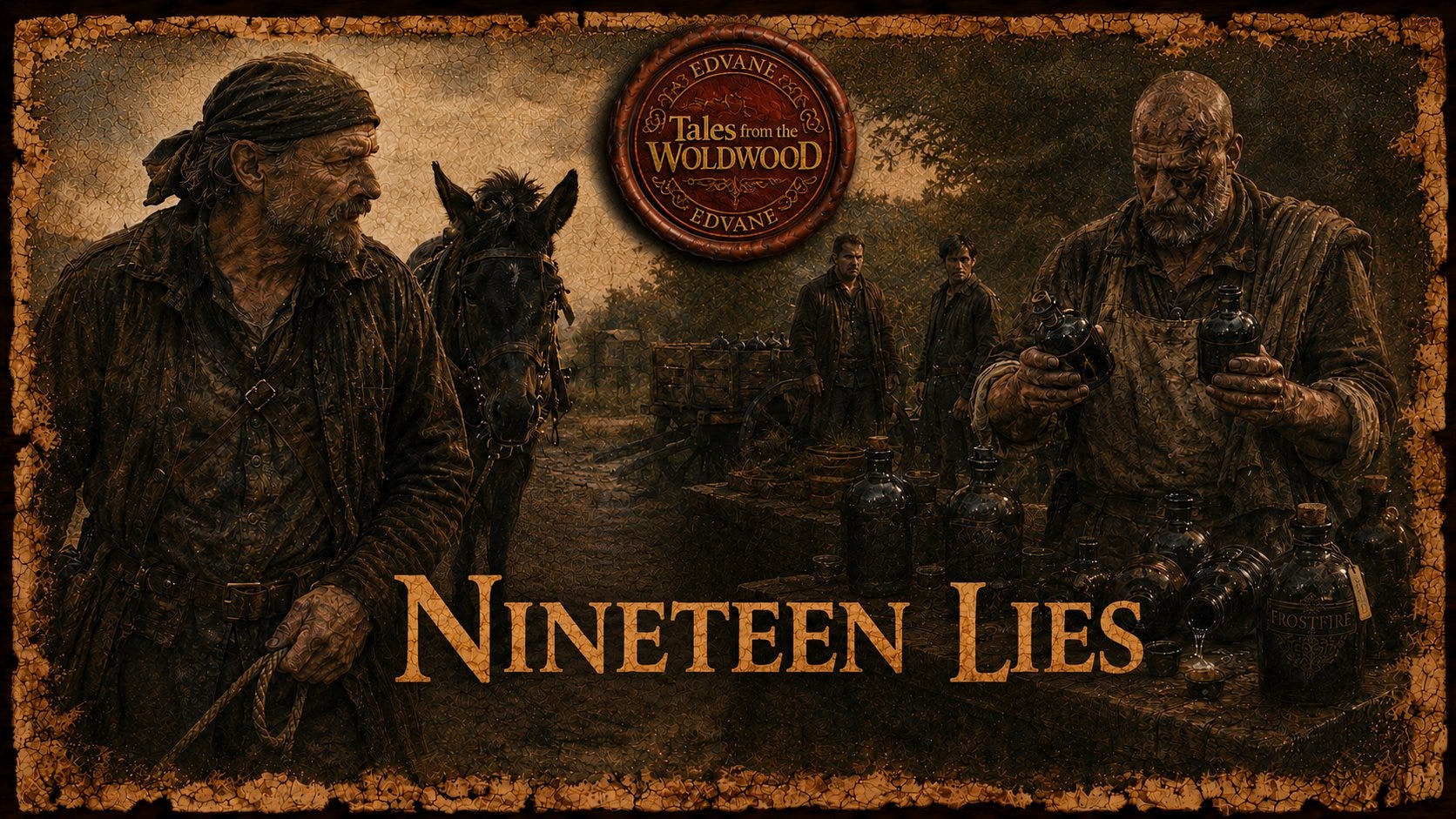
You are about to hear a story from the Woldwood. It concerns two foresters, a road that still pretends to be useful, and a bargain that made sense at the time.
Orin Mosswood had them moving early. He said the light was better for judging bark and ground, and he liked to put miles behind him before the day warmed. Ras Harram did not argue. Ras had the shoulders for hard work and the temper for getting it finished. Jon Lyle followed at his side. Slimmer, quieter, watching the line of trees, and the small lives beneath them, with the care he gave to everything that did not speak. They walked together for a time beneath the Woldwood’s edge, where the branches still allowed a little sky through. They spoke only to agree what needed doing. Orin was to take the southern line. Ras and Jon would go east, toward the Old King’s Road, and mend a marker that had been left too long. It was all ordinary. A morning plan. A division of labour. No omen, no argument, and nothing out of the ordinary.
Orin left them, and Ras watched him go, then looked at Jon and jerked his chin eastward to the treeline. “Come on,” he said. “We’ll be back for noon if you don’t stop for every track in the mud.”
They went just far enough that the trees drew back a little and the ground still lifted back toward the road. The eastern side had a different feel. Ras preferred it, saying the work went faster. Jon liked it too. There were more birds there, more signs of small things moving and living and making use of what the forest provided. They found the marker after an hour. A post set in a stone bed, leaning more than it should, with the old cut on the side half grown over. It had been straight when it was placed, but they both knew that in time everything straightened by men leaned back. Ras knelt and set his shoulder to it, while Jon fetched what was needed. There was no talk beyond the work. When it was done, Ras rubbed his hands and looked in the direction of home.
“We’ve time,” he said. “Let’s take the road edge back. Might find something worth bringing in.”
Jon nodded. He always nodded when Ras said there was time. The day ran by his sense of it, and that was usually fine. The resting place was not much. A shallow pull-off in front of the trees where the road widened, with a flat stone that travellers used for sitting on, and a low stump that served as a table. The road itself was older than anyone in Broch Heel, a hard scar through ground that would much rather have closed up again. People still used it though. Traders and messengers, foresters and hunters and men with nothing to lose.
They saw a donkey first, then the cart. A man sat on the flat stone with his back to them, and his hands resting on his knees. He looked up when he heard them and smiled as though he had been expecting them. “Foresters,” he said to himself. “Thought I’d be alone for longer.”
Ras did not return the smile. He kept walking until he was close enough to see what was on the cart. Jon offered the man a cautious greeting, while Ras simply stood there and took him in. The man was lean, with a face that had been broken once and healed without care. His clothes were serviceable but worn, and patched with thread that did not match. There were two knives at his belt and a third tucked in the top of his boot. He looked like someone who rarely stepped aside.
“What are you hauling?” Ras asked.
“Name’s Fredor,” he said. “Fredor Gragg. And I’m hauling my luck, same as everyone.”
Jon glanced at the donkey. The animal’s ribs showed faintly under its coat, but it looked healthy enough. Ras looked at the cart again. In the bed of it were flasks. Black glass. Neat rows of them, tied down with rope. The sight of them was so out of place there, on the edge of the old road.
“Those?” Ras asked.
Fredor followed his eyes as if he had forgotten the flasks were there. “Ah, right. Yes. Those.”
Ras waited.
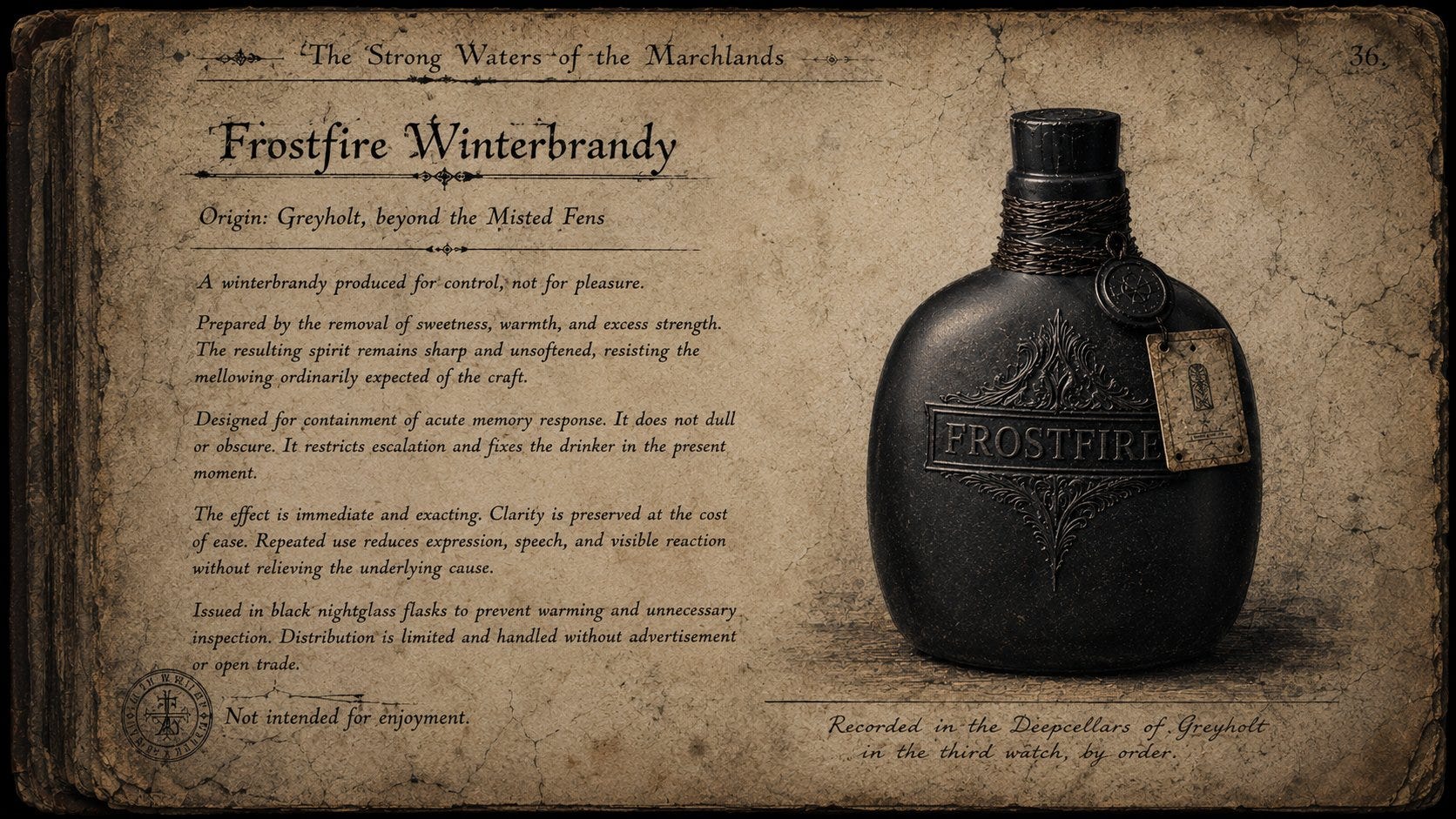
Fredor shrugged. “Winterbrandy,” he said. Then, as if he were correcting himself for lack of precision, he added, “Frostfire Winterbrandy. From Greyholt? The Deepcellars?”
Both Ras and Jon knew the name. Everyone in Broch Heel knew the name.
“Greyholt Abbey is four days from here,” Ras said, sternly.
“A man can walk four days,” Fredor said. “A donkey can lope four days. A cart can roll four days if it’s not asked to fly.”
Ras looked at the flasks again. “Why bring them here?”
Fredor grinned. “To sell them. What else?”
“To Pike?” Ras said.
Fredor laughed derisively. “To Pike? Your tavern-keep has untrusting eyes, friend. He would turn these over, count the seams, measure the mouth, and tell me the moulding was off before I’d breathed a word. Besides, Pike would never buy this many. Not in one go. Not unless he’d ordered them and paid in advance.”
Jon watched Ras’s face. Ras was doing sums already. Fredor could also see it. He was counting on it. Ras disliked strangers on principle, but he did like numbers when they behaved.
“Where are you going then?” Jon asked.
Fredor pointed east with his foot. “Gefroy Castle,” he said. “Speculative visit. They didn’t order. I’ll take my chance though. The steward might want them. Might not. Either way, I don’t fancy turning back.”
“Osric won’t buy twenty flasks from a man he’s never seen. You’d be better with Pike,” Ras said.
Fredor did not argue. He only said, “No, but they might buy two. Or five. Enough to make the road worth it.”
Ras readied his pitch. “And what makes the road worth it, Mister Gragg?”
Fredor leaned forward, elbows on his knees, as if they were three men sharing a simple truth. “It costs me to get them,” he said. “It costs me to carry them. It costs me to eat. I need ten curns a flask just to break even. Ten. Anything less and I’m working to stand still.”
Jon kept his face neutral. Ten curns was a lot to him. He earned in drips, like most men in Broch Heel. He had coin, but it was coin that had names attached to it. Messrs rent, food, boots and winter.
“And profit?” asked Ras
Fredor spread his hands again. “Profit makes a journey worth taking,” he said. “I’m not asking for charity. I’m asking to be paid for the road.”
Ras looked at the cart again. “Pike pays thirty for Frostfire,” he said.
Fredor shrugged. “Pike pays what Pike pays.”
Ras could not help himself. “If a man wanted to move twenty flasks quickly,” he said, “he’d sell them to Pike. Pike would buy if they were real.”
Fredor smiled. “If they were real?” he said, seemingly amused by the obvious.
Jon felt the change before it completed. Ras was taking hold of the idea. Not the drink. The margin. Twenty flasks. A tavern-keep who liked profit and liked to be the one with something rare behind the bar. There was a path through it that ended with coin in Ras’s hand, and Ras rarely ignored a clean opportunity for that.
“You’d sell to us?” Ras said.
Fredor looked right at him. “Would I?”
Ras reached into his pouch and pulled out what he had. Not much, but enough to flash, enough to show he was not dreaming. “We’ve work,” he said, as if that explained everything. “We don’t want to drag this out. You take a modest profit, we take the lot, you go on your way.”
Jon opened his mouth to caution Ras. He could sense a mistake forming, and he could also see that Ras was already stepping into it.
Fredor noticed and looked at Jon, anticipating his resistance. “You’ve got the face of a man who worries,” he said. “No shame in it.”
Jon said, “It’s a lot of coin. And a lot of trust.”
Fredor nodded, showing outward respect for the point. “ Listen. I’ve got a wife, and children. I’m not begging. I’m saying I’ve walked four days to make a little comfort out of winter. You’d deny that on the strength of your doubt?”
Jon felt his cheeks warm. He hated being made to feel mean, especially by someone who looked like he had learned to survive by leaning on pity. He glanced at Ras, hoping for a lifeline. None came.
Instead he piped up again, “Let me taste it.”
Fredor did not hesitate. He reached under the cart, took a cup from his knapsack, and picked up one flask. He pulled the stopper with a twist and poured a small measure, holding it out.
Ras took the cup, sniffed, and drank. The change in him was immediate. His eyes widened slightly. The hard set of his mouth loosened. “That’s it,” he said.
Fredor watched him with calm interest. “That’s it,” he agreed. “If you’re convinced, you can also take the cart for a small additional consideration”
Ras handed the cup back and held out his hand. “Done,” he said.
Fredor clasped it with a firm grip. Nothing threatening. He was simply a man who did not let go first. Then reality returned, stubborn and dull. Ras counted what he had. It was not enough. Not even close. The idea had outpaced his purse.
Jon had the answer, “We can get the rest from Broch Heel?”
Fredor’s eyes went toward the town as if it were a smell he did not like. “I don’t go back on my road,” he said. “Costs me time. Costs me daylight.”
“Wait here. He’ll go. I’ll stay,” said Ras
Jon glared at Ras and sighed heavily. “Ras,” he began.
Ras cut him off. “Go,” he said. “Get the coin. I’ll settle with you later. We’ll have this done before Pike’s evening trade.”
Jon went. He walked fast, but he told himself it would be fine. Ras knew what he was doing. Ras had tasted it. Ras did not get taken in by clever words. When he returned, out of breath, with his purse heavier and his mind lighter mainly from the fact that the walking was done, he found Ras still at the resting place and Fredor still with him, sitting on the stone. The donkey stood with the cart, but the rope had been loosened and retied. The flasks were arranged more neatly than before.
Ras held out his hand for the coin. Jon hesitated, looked at Ras, who nodded, then gave it. Fredor counted it quickly and smiled. He did not say thank you. Men like him just didn’t.
“And the cart?” Jon said. “You said you’d sell it for a song.”
Ras answered, “He did.”
Jon stared at him. “You bought it already?”
“We’ll need it,” Ras replied. “Pike will pay. It’s all the same. We can think about what to do with it after.”
Fredor stepped up onto the road, took the donkey’s lead, and handed it to Ras. He bowed, turned and took a step away, then another, and then he was away. He looked back once, checking that the trap had closed. He chuckled under his breath. “Never fails,” he said, and then he was walking east, having just been relieved of a burden and remained undiscovered once again.
Ras and Jon hauled the cart toward Broch Heel and then on to the Crooked Mare, the flasks knocking softly against one another with each jolt of the road. They arrived with the glow of men who believed they had outsmarted the day. Pike was inside, wiping a cup, his face unreadable in the way it always was when coin came close. Ras told him what they had. Twenty flasks. Frostfire. Greyholt. A bargain. Pike listened intently. He went outside, approached the cart and took one flask in his hand. He turned it. He weighed it. He ran his thumb along its surface. Jon watched his eyes. Pike concentrated on the glass.
“This is small,” he said.
Ras spoke, “It’s Frostfire.”
Pike continued his appraisal, “Greyholt flasks are taller. The mouth is also cleaner, and the moulding is sharper. Also, this is not nightglass.”
Ras’s face hardened. “Taste it, I tasted it. It’s real.”
Pike did not argue. He went back inside the Crooked Mare and returned with a flask of his own. He set it down beside theirs.
The difference was immediate. Pike’s flask had a depth to it, a black that was not painted on. It repelled the light in a way the others did not. Ras stared as if a branch had struck him. Pike took the genuine flask Ras had pointed to, opened it, poured a measure, and tasted it. He nodded once.
“That one’s true,” Pike said.
Jon felt a surge of relief that made him dizzy. Ras’s body loosened as he briefly thought the world had righted itself. Then Pike picked up another flask and opened it. He poured. He tasted. His face remained expressionless.
“That’s ordinary winterbrandy,” he said. “Not bad. Not special either.”
He opened another. The same. Then he opened another and sniffed before he tasted. He poured it out onto the floor and watched it splash. “That’s nettle tea,” he said.
He opened more. With each flask, the day grew heavier for Harram and Lyle. When he was done, he looked at them with the knowing eyes of a man who had watched others learn this lesson before. A single flask of genuine Frostfire, five of tavern winterbrandy and fourteen teas.
“I make my own,” Pike said. “Better than that,” he said, nodding toward the common stuff. “I won’t pay for it. I’ll take it off your hands if it helps you swallow the loss. I won’t pay for tea. For the one flask of genuine Frostfire, I’ll give you twenty-five curns.”
Ras’s jaw worked. He was doing the sums again, faster now, and seeing the same dead end from every angle. Jon said nothing. He felt empty.
Ras looked at Jon, and Jon nodded, “Deal.”
The sale was quick. Coin changed hands. Flasks moved to the rear. The cart and donkey were led away. Their fine scheme, their clever margin, all of it collapsed into a single, honest transaction and a thin scrape of pride across the floor. When it was finished, Pike invited them inside and poured two measures of Frostfire, the real thing, from his own flask. He set them down in front of the two men as they told their sorry tale.
“Drink,” he said and let out a short laugh. “You two,” he said. “Foresters. Men who can tell a deer track from a hare’s at twenty paces. And you bought painted glass from a road rat with knives on his belt.”
Ras did not rise to it. He just drank. Jon managed a smile. “He had one real flask,” he said, as if that meant anything now.
Pike shrugged. “That’s how it works,” he said. “One taste of the truth to sell you nineteen lies.”
Ras Harram wasn’t wrong about the drink. He was wrong about the man. Most mistakes aren’t made because we don’t know enough. They’re made because we stop checking once something tastes right.
Tales from the Woldwood is a free 40-story descent into the Marchlands. The forests, ruins, people, monsters, bargains, and histories that shape the world before the first novel arrives