

Draegel's Settled Account
Tales from the Woldwood - Story 27

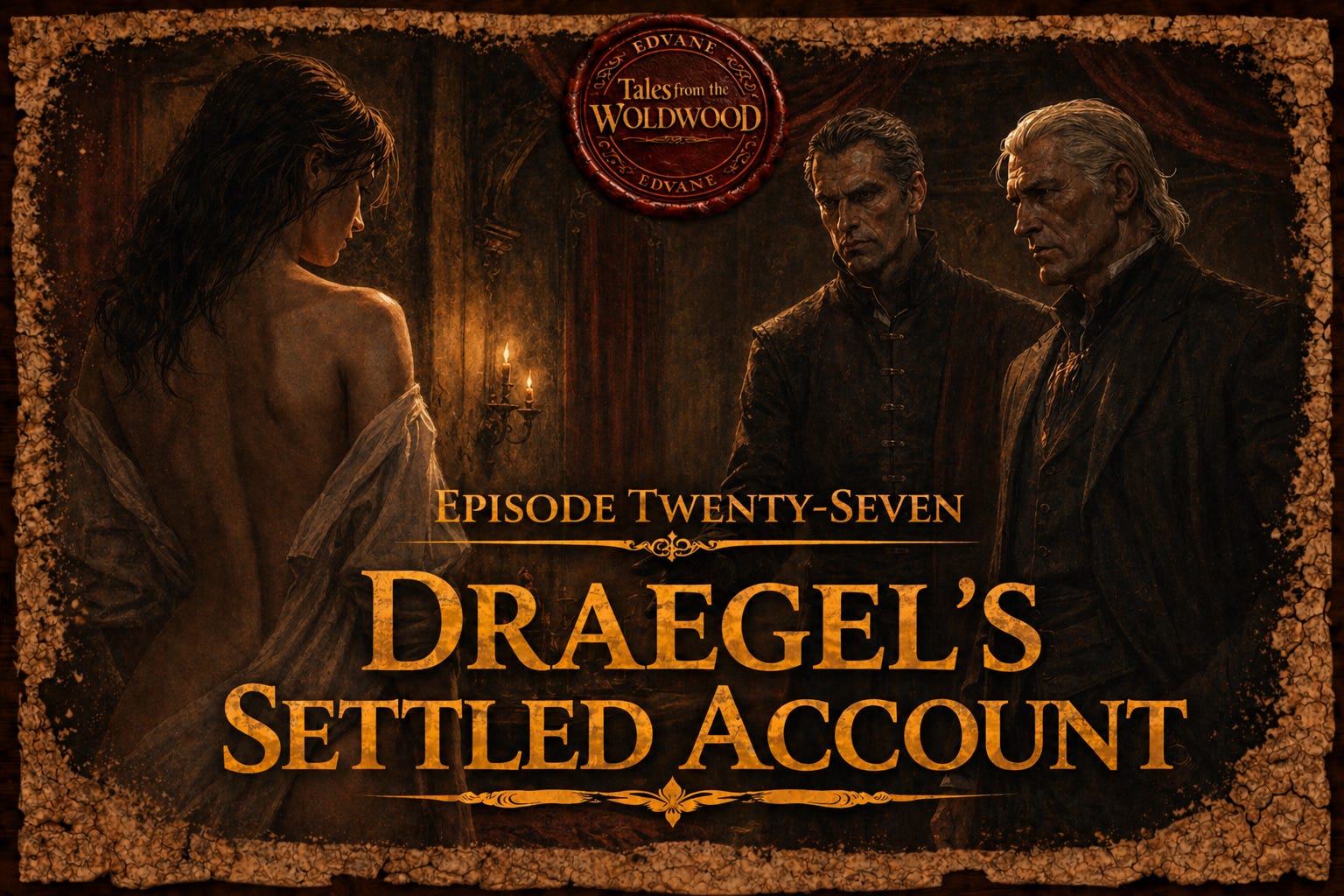
The account you are about to hear was not written for confession or instruction. It was recovered from a ledger in the City of Lenth, written in a hand which does not appear in any civic record. But be advised. Some accounts are preserved to act as warnings alone.
I went to Lenth because it sold itself well.
The city had a reputation for discretion, which is rarer than virtue and far more useful. Its streets were narrow enough to encourage conversation and clean enough to suggest oversight. Its people understood the value of looking away at the correct moment. I did not need to hide my wealth there. I needed only to spend it with confidence.
I wore a mortal shape that invited trust. Tall, well-dressed, neither young nor old enough to invite questions. I let the rumours find me rather than the other way around. Within three days, I knew where coin flowed most freely and who took a share before it reached its destination.
That was how I learned of Alderman Hollister. He was spoken of carefully, which is how men like him prefer it. Not corrupt, exactly. Practical. Willing to smooth introductions, facilitate access and recommend establishments that catered to particular tastes. He did not frequent such places himself, or so it was said, but he knew who did. He understood the city’s appetites without sharing them.
I arranged an introduction.
He received me in a public house favoured by councillors who wished to be seen among ordinary people without risking conversation. Hollister was neatly dressed, his beard trimmed, his hands clean. He drank moderately and listened well.
“You’re new to Lenth,” he said.
“I am,” I replied.
“And wealthy, Mister er…?”
“Draegel. I’ve found it useful.”
He smiled at my name. It was a small thing, but it told me enough. It was the moment Hollister understood both who and what I was. He sowed neither fear nor outrage. Only adjustment. He had heard my name once, long ago, and I saw the realisation rest in his eyes. He did not test me and did not reach for courage he did not possess. He chose the smallest motion available to him and made it correctly. He finished his drink, straightened his coat, and continued as if nothing had altered except the stakes. In that moment, Hollister ceased to believe he was arranging indulgences for a wealthy stranger and accepted that he was managing proximity to something else, and that acceptance pleased me. It meant I would not have to waste time convincing him of something he already knew.
I told him I was seeking a companion. Not a wife. Not an employee. Someone discreet, adaptable, and unburdened by local attachments. Someone who could travel and not be missed. “A personal attendant,” I said. “Chosen carefully.”
Hollister considered this. I let him. Silence encourages men to speak honestly if they believe you have already decided.
“There are places,” he said eventually, “where introductions can be made. People who understand such arrangements.”
“I would expect nothing less.”
“And you are prepared to pay for discretion?”
“I am prepared to pay for results, Hollister.”
That was when he accepted my coin. We began that night.
Lenth’s better brothels did not proclaim themselves. They hid behind respectable façades and offered wine before anything else. Their keepers were polite, efficient, and accustomed to men who mistook indulgence for entitlement. Hollister moved easily among them. He knew names, and he understood the rules.
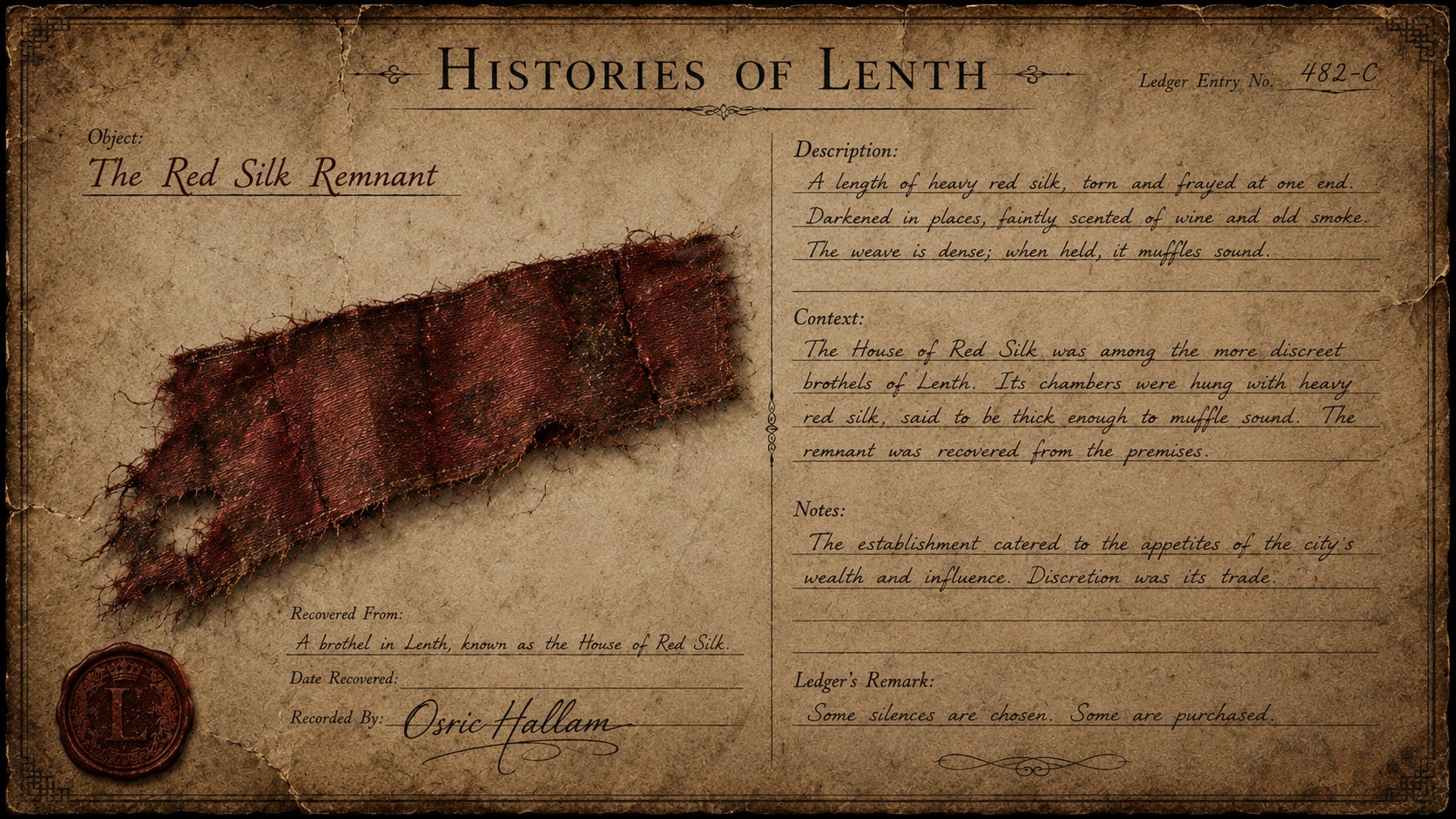
The first venue Hollister took me to, the House of Red Silk, smelled of wine and heat and something sweet laid over something fetid. The Red silk hung from the ceiling beams, heavy enough to muffle sound, and the women were accommodating and had learned where not to look.
The keeper brought one to me without asking my preference.
“She’s quiet,” he said. “Does what she’s told. Never refuses.”
The woman knelt because that was expected. She did not look at me. She had learned the value of not anticipating pain.
“Stand,” I told her. She obeyed immediately. “Undress,” I said, and again she complied.
I circled her slowly, letting my eyes linger where men’s eyes usually linger, and long enough for her to flinch despite herself. Her body bore the quiet record of repetition rather than violence. Faint bruising along the upper arms, a thin pale line beneath one breast where a healed cut had been reopened once too often, the soft discolouration at her hips that came from being turned and positioned rather than struck. Her skin had learned to recover quickly and hold itself ready for the next instruction. She did not try to hide the marks. They existed in the open like wear on a well-used tool.
“What do you want?” she asked finally.
That question interested me more than she did. “Nothing you have,” I said.
She looked up, confused, and for just a moment, hope surfaced where it had no business being. I dismissed her with a gesture.
Hollister laughed awkwardly as we left. “Too plain?” he suggested.
“Too present,” I replied.
The next place was quieter. The Velvet Rooms. Private rooms. No music. Thick carpets that swallowed footsteps.
This one chose herself.
She came to me boldly, touching my arm as though she owned it already. She spoke softly, describing what she was good at and what men returned for. She had learned how to sell anticipation effectively, which I thought impressive. I disrobed, and when I told her to undress, she did so with confidence. When I told her to stop halfway through and whispered my instructions, irritation crossed her face before she could mask it.
“That costs extra,” she said.
“Does it?” I asked.
I reached out and pushed her chin upward and pressed into her until she wilted. She did not pull away. She did not submit either. She endured it.
“Tell me,” I said, “what would you be if this place burned tonight?” Her mouth remained closed. The answer did not exist yet.
When I was done, I dressed. She dressed in silence, anger settling where seduction had been.
“She’d have learned,” Hollister said later, defensively.
“Eventually,” I agreed. “Too slowly, though.”
Then on to a place I’m calling the upper floor. The keeper himself led us upstairs, past locked doors and guarded smiles. “This one is special,” he said. “Not many are allowed up here.”
The woman waited on the bed, naked already and arranged carefully. She watched me enter, welcomed me and began to writhe a little and touch herself, possibly to give me encouragement. I was told that she had been taught how to please men who believed themselves dangerous. I sat down and let the silence stretch.
“You can touch me,” she said eventually.
I smiled. “No,” I said. “You can stay exactly where you are.”
Minutes passed and uncertainty crept in, then discomfort. She looked afraid to make the wrong choice.
“What’s wrong?” she asked.
“Nothing,” I said. “I was only checking.”
“Checking what?”
“How long it takes before you disappear.”
She understood enough to be frightened at that point, which was extraordinarily satisfying for me, but I stood and left her untouched.
Downstairs, Hollister was sweating. “You’re hard to please,” he said.
“I am very easy,” I replied. “You simply misunderstand what I want.”
Women were presented to me all night as if they were goods. They were praised for temperament, experience, and reliability. None of them frightened easily. None of them were surprised by wealth or interest. They assessed me as quickly as I assessed them. I pleased myself with some but declined them all.
Hollister mistook my refusals for refinement. “You have exacting standards,” he said on the second night, laughing a little too loudly.
“I have specific needs.”
“Of course. Of course.”
We drank. We moved on. The pattern repeated over several evenings. Different establishments. Different keepers. Different whores. The same misunderstanding. They believed I was looking for pleasure. Hollister believed I was difficult to satisfy. In truth, they were all wrong. The women of Lenth’s houses were too formed. Too alert. They had learned how to survive what was asked of them and keep something aside for themselves. I do not begrudge them that. But it made them unsuitable. I was not looking for resilience. I was looking for absence.
By the fourth night, Hollister was comfortable. He drank more freely. He spoke of the council with faint disdain and of his service with pride. He readily accepted heavier purses. “You could stay,” he said at one point, gesturing vaguely at the city beyond the shutters. “Lenth rewards men who invest properly.”
“I do not stay long anywhere,” I replied.
That was true enough. When I decided to leave, I did so abruptly. I told Hollister I had not found what I wanted and would seek it elsewhere, although the Black Bogs of Mock were looking inviting by this stage. He protested mildly, more out of wounded pride than genuine interest, I suspect.
“There are still places I could show you,” he said.
“I doubt it.”
I asked to settle accounts in his office, out of courtesy. He agreed readily. Men like Hollister enjoy the appearance of formality at the end of transactions. His room overlooked a narrow street that rarely saw direct sunlight. It was orderly, lined with shelves of ledgers and civic seals. He offered wine. I declined.
She entered while we were speaking. She was carrying documents, her arms full, and her attention elsewhere. She moved through the room with assurance. She belonged there. She was younger than I expected Hollister’s daughter to be, and calmer.
I felt the moment settle.
She looked at me briefly. Not appraising. Merely curious. Then she turned to her father. “You asked for these,” she said, setting the papers down. That was all. She left the room again, and Hollister did not notice how still I had become.
“That will do,” I said.
“I beg your pardon?”
“She will suffice.”
He stared at me. At first, he did not understand.
“My daughter? Clara? No,” he said finally.
“Yes.”
The room changed. He rose from his chair so quickly it scraped the floor. His face flushed, and then fear arrived. Late, but dragging his outrage behind it like a cloak.
“That is not. This is not what we agreed,” he said.
“We agreed to nothing beyond introductions,” I replied calmly. “Which you provided.”
“She is not. Clara is not for sale.”
“No,” I said. “She is not.”
That was when he understood enough to be genuinely afraid. He spoke of guards. Of authority. Of exposure. He threatened to raise his voice. I let him finish.
“You have taken my coin,” I said. “You have walked me through half of this city. You have allowed men far worse than me to believe you facilitate such things. If you shout now, Hollister, what do you imagine they will say of you when asked?”
“You will be denounced,” he said, weakly.
“I will be confirmed,” I corrected. “And you will be advised, very earnestly, not to anger me.”
He sagged back into his chair.
“She will remember none of this,” I told him, not unkindly, I thought. “By the time I am finished preparing her, she will not remember Lenth. Or you. Or herself.”
“You cannot.”
“I can,” I said. “That is why you knew my name when I first spoke it.”
I left him. There was nothing more to discuss. I departed Lenth before dawn, and Clara with me.
Months later, I returned my attention briefly in Lenth’s direction again. Alderman Hollister had been found hanging in his office. The door had been locked from the inside, and beneath him sat a sack of crowns, untouched. The city whispered for a while. Then it moved on. I marked the investment as concluded. Lenth continued. Hollister did not.
There are worse failures around the Marchlands.
Draegel
Moral rot begins the moment a person decides that convenience outweighs conscience. Each compromise makes the next easier, until wrongdoing feels administrative rather than chosen. What finally destroys a man is the habit of believing he can manage it without becoming part of it himself.
Tales from the Woldwood is a free 40-story descent into the Marchlands. The forests, ruins, people, monsters, bargains, and histories that shape the world before the first novel arrives
Listen on YouTube: