
An Ogre Denied
Break. Take. Carry Home.

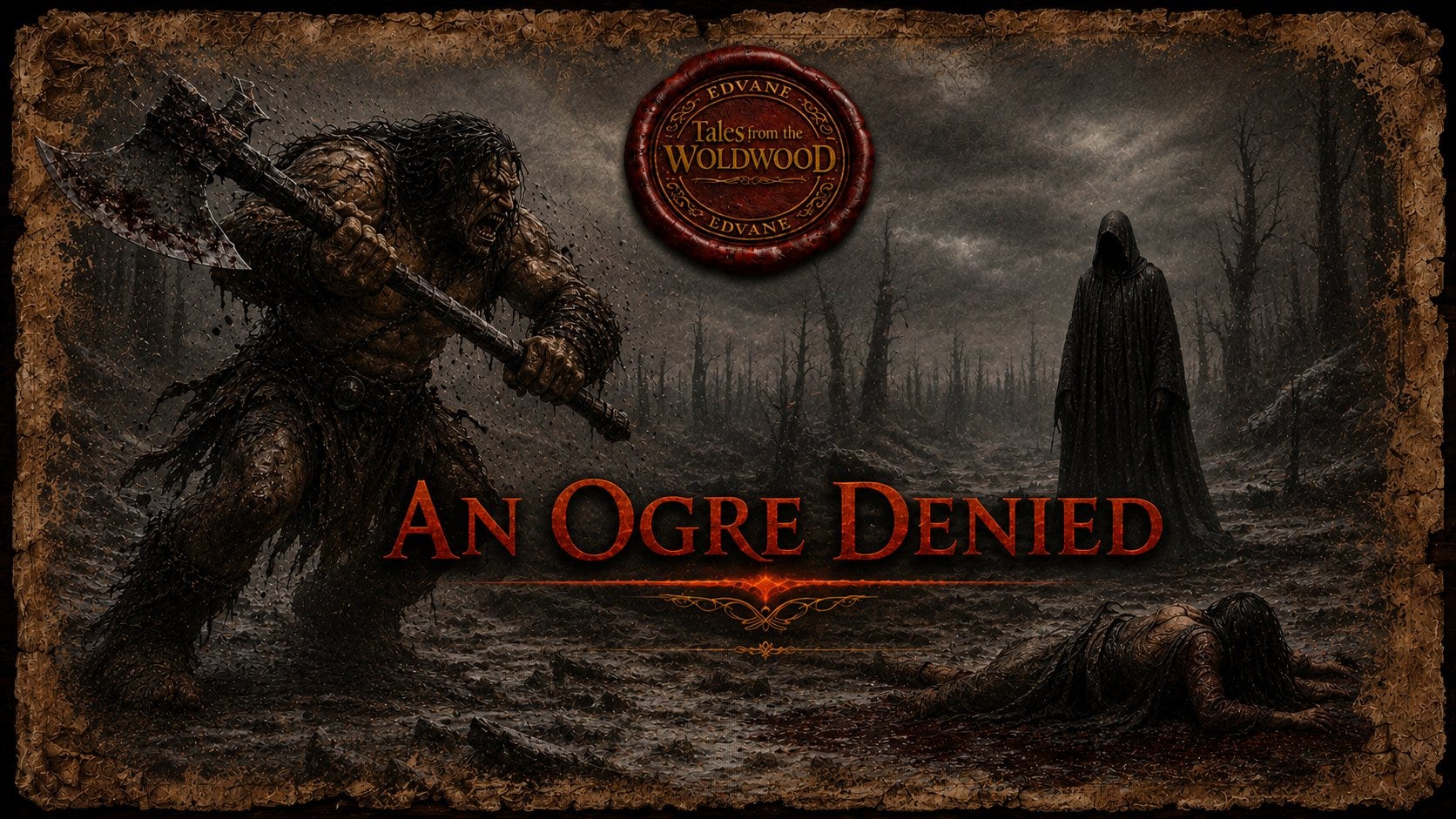
Today we look once more into The Shivering Vale. I cannot say when it was, only how it was.
Into it came a creature built for one purpose only. To break what stands before it and take what remains.
Rain soaked the ground, making every smell heavier. The wind pushed, and it never stopped. Water ran down the faces of the huts and off the edges of the roofs, neither fast enough to be a flood nor slow enough to be ignored. All around, the fires fought to stay alight.
He stood in the ring of trampled mud and hard grass with his feet set wide. The ground sucked at his soles, and he liked it. Others formed a rough circle around him, bodies packed close and shoulders hunched under soaked hides. Across from him, the other one lifted his axe. It was a single-handed tool, thick-headed and chipped, good for splitting wet timber and skulls that deserved no better. A sound rolled in from the watchers, not words, though. A vibration in their throats. It meant begin and take what you can. He lumbered forward without thinking, driving his shoulder first and trying to close in. The other one swung an axe at his head. He ducked and felt the wind of it skim his wet hair. He rose into the other one’s chest and smashed his forehead into the face. Bone met bone and the other one staggered, blood running from his nose. Neither of them fell.
The other one tried to hook the axe into his ribs, but he caught the haft in both hands and wrenched it as the other one held on. They both strained, their feet sliding in the mud and the rain making it worse. The watchers looked on eagerly. None would intervene because if help came, the contest would mean nothing. He twisted his hips and dragged the other one off balance. The axe tore free, so he threw it aside, and it landed in the mud with a wet slap. The other one now reached for a knife at his belt, but he saw it and moved first, gripping the wrist and bending it back until the tendons pulled hard. The other one growled, and the sound spurred him on because it meant the other one still believed.
He smashed his fist into the throat and the other one choked. He drove the wrist down, forced the knife loose, and kicked it away. Then he wrapped his arms around the other one’s torso and lifted. He could feel the ribs flex under his grip, and he heaved, throwing him onto the ground. The other one hit the mud, rolled and tried to rise. He stepped quickly onto the chest and pressed down hard. The other one’s arms flailed, and he pushed his weight down until the flailing stopped. He held it there and waited so that the watchers remembered who stood above. The other one’s eyes rolled, and his mouth opened, seeking air that would not come, and he went still. Not dead, just alive enough to know he had lost. He lifted his foot and then squatted and grabbed the other one by the hair, dragging his head up out of the mud. He looked into the eyes and showed his teeth. He let the head drop and the other one lay in the ring, coughing mud. The watchers rumbled again. The sound meant proven.
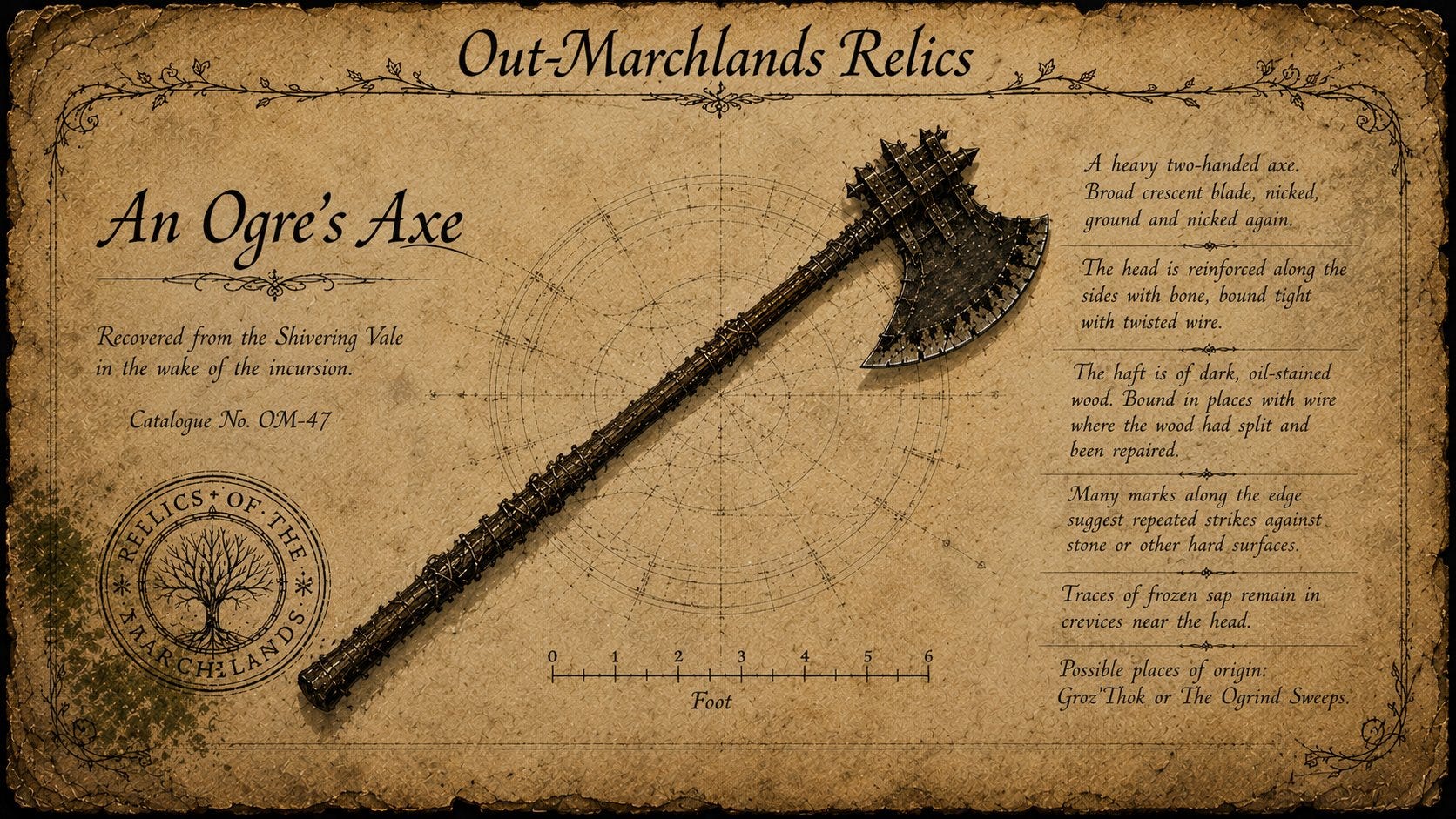
Hands reached into the ring, carrying the two-handed axe. It was not given for ornament. The haft was thick, darkened with oil and wrapped in places with wire where the wood had split long ago and been forced into continued service. Bone ran along the sides of the head where the metal had been reinforced, bound tight with twisted strands. Its blade was broad, nicked and ground and nicked again, and there were marks on it from strikes against equal surfaces. A tool like this did not belong to the weak because the weak could not lift it without shame. They held it out, and he took it with both hands and raised it aloft as the watchers cheered. It felt right, and he swung it once, feeling the balance. He could kill with this, split doors, even break another in half and still have the strength to move.
The watchers began to beat and chant, faster and faster, and he knew this was the signal to blood his new weapon. He swung around, raised the axe with both hands and then sank it between the eyes of his choking opponent. Blood and brains spattered into the air and mixed with the mud. He raised it once again, now dripping red with blood and bone, and the watchers cheered once more.
He walked out of the ring and through the cluster of huts, passing fires that hissed and dimmed under the drizzle. Children watched from doorways, their eyes flat and unblinking, their hands already strong from hauling and striking. One of them held a small hatchet and dragged it along the ground, leaving a line in the mud. A female stood under an overhang, her hair braided tight to keep it from tangling when her hands were busy. She watched him pass with a look that would not put anyone at ease. She had a knife at her belt and a scar on her cheek. She would never be as strong as him, but that did not make her gentle. In a place like that, nothing was gentle. Beyond the huts, the earth sloped down toward black water. Along the shore, men and women worked in the rain with rope and hooks, hauling a carcass from a net.
He moved toward the stone cleft where the gate waited. It was not always there and was most often just rock and wet lichen. But sometimes it became more, and the cleft-watchers stood in the rain with their backs against the rocks, eyes fixed forward, waiting for the change. When it did change, it was used, and today it was open. The rock in the cleft looked as if it had been deliberately split. A darkness sat between the two halves, and air came from it that was not their air. It carried a smell that did not belong to their world. Those who would go were gathered and armed with axes, spears, clubs and hooks. They carried bundles of rope and sacks for all that would be taken. There was no laughter or talking, just chewing tough meat and swallowing.
The watchers at the cleft rumbled, and the first of the ogres stepped forward and into the darkness. A second followed, and the line moved slowly forward. When his turn came, he shifted the axe into both hands, holding it ready, and stepped into the dark.
The place was open. Trees stood close, their branches bare and hard, and his breath showed and was pulled away fast, but he did not care. Cold was cold. The others spread out, moving between the trunks. They all knew how to move, listen and smell for fire or flesh, but there was no fire, smoke or voices there. He lifted the axe and struck a low branch to test it. The blade bit and the wood split clean. The sound rang and then seemed to die quickly. He liked it, because a place that swallowed sound could hide him.
They moved deeper but found nothing living that ran. No deer or boar tracks. The forest was too still, but that did not stop hunger. A few of the others began to mark trees with their blades. They slashed the bark to claim them. The taking usually followed the claiming.
He saw something ahead between the trunks, a shape of stone that did not belong. Walls, far off, rising out of the ice. It was a fortress in the distance, and instinct told him that meant mortals, or beings like them, and that meant stores of food, iron, cloth and tools. He felt the pull that just meant go. They approached the edge of the trees and saw the keep more clearly and the nearby lake. It stood hard and old against the Vale, but it was just another place to break. The others began to move toward it in a loose pack. Their intent, if it could be called that, was simple. Take. Break. Carry home.
He did not see them at first. Something drew his attention, and he turned his head to see a hooded figure drifting between trees. It did not walk. It moved as a leaf moves on water, carried without effort. No hands showed beneath the sleeves, and the face beneath the hood was smooth, with only a faint suggestion of where eyes and mouth should have been. Anger was his first answer to anything strange, and he lifted the axe and took a step. The figure drifted back. Another appeared beyond it and then another. Hood after hood with pale faces and silent bodies. One of the others roared and charged, axe up. He was big, heavy and sure. The hooded figures did not move aside. They became many. They were suddenly everywhere in numbers that broke sense. The charging ogre reached the first hood and swung. The blade cut through nothing, and the figure remained untouched, drifting. Then the charging ogre was no longer whole. Flesh came apart but not cleanly in cuts and slices. It was just a ripping and breaking, wet and immediate. The ogre’s body exploded into chunks that struck the ground with heavy thuds. Blood sprayed and steamed in the cold. Bone showed white for a second, then was buried beneath meat.
Another ogre swung, and his arms were torn from his shoulders. He screamed, and his chest burst open. The Shepherds drifted around him, and he also became a pile of thick red pieces. The forest then filled with the sound of tearing flesh. The Shepherds did not grunt or shout. They descended, and where they touched, the bodies were minced and scattered across the white, the mud and the roots. He saw heads roll, legs twitching without bodies, others dragging their own torsos across the ground, their innards trailing in their wake before heads and chests burst open. He saw the two-handed axe in his hands and knew it meant nothing in that place. Anger surged, but something beneath it pushed hard. A recognition that this was not a fight. It was a breaking. The others were dying all around him. Wet chunks bounced off tree roots. A head lay on its side staring up, eyes open, mouth working uselessly. A Shepherd drifted over it, and the head became mush, the face instantly destroyed.
He turned and fled because his body knew the only answer left was not being there. The forest swallowed him as he plunged between the trunks. He shoved through branches and did not look back. The Shepherds followed, and he tried to move faster. Mud grabbed his boots and roots caught at his ankles. He jumped and landed badly, pain flaring in his knee, but pain did not stop him. Eventually he came to a fallen trunk and slid behind it, pressing his body down into the earth and holding still. Stillness was a good tactic when hunting in rain and wind. If you were not seen, you were not prey. He listened to the tearing sounds and wet thuds continuing until there were none. The forest became quiet again after the slaughter. Still he did not move.
A Shepherd drifted past the fallen trunk. It was close enough to touch him, but it did not look. It did not search as a hunter searched. It drifted, and behind it more drifted. They moved in patterns that meant nothing to him.
He lay there, still pressed into the mud, and did not move. A long time passed and his muscles began to cramp from holding there. Eventually he risked a slow turn of his head and could see the Shepherds were farther away, drifting toward the open space near the keep. Not quite gone, but elsewhere, and he rose, carefully.
He advanced in the opposite direction from the keep, deeper into the Vale and away from where the Shepherds gathered. He expected to find the gate again but found none. The ground rose and fell, but the shapes repeated. A boulder that looked like a crouched beast. A cluster of twisted roots. A dead tree split down the middle. Then again. Then again. He marked a trunk with his blade and moved on. Later he found the mark on a different trunk. He stared at it, and his confusion became anger, so he struck the tree and split it.
Hunger grew. At first it was a hollow in the belly. Then it became a claw that ate his thoughts. He licked rain from his lips and tasted nothing. He searched for animals but found none. Nothing that lived moved there, or if it moved, it did so where he could not see. He found meat though. The slaughter had left it everywhere near the keep, chunks scattered across the ground. He crept back to it in the dim light, drawn by the smell. He found an arm, thick and red, muscle still clinging to bone and tore into it with his teeth, chewing hard. The meat was cold and gritty with dirt, but he did not care. Food was food. He ate until his stomach cramped. He swallowed blood and mud and drank from puddles. He did not think about what he ate. Ogre flesh, the flesh of his kind. That meant nothing to him. The weak died, and the strong ate. He left the corpses behind and moved again.
The Vale did not offer him paths, though. It offered repeats. He crossed the same stretches again and again. He circled a lake edge and found it changed. He stepped onto it once and felt the surface shiver, so he moved along the shore instead, keeping the land underfoot. He began to strike things. At first it was to test. He drove the axe into roots. He split stones. He hacked at trunks until sap bled out. The sap smelled wrong, and he hated it. He struck again and again until his arms burned and his shoulders ached.
Eventually, he found a place where a single standing stone protruded from the ground, covered in ice. He rammed it with his shoulder, but it did not give. He swung the axe at it, but the blade struck and bounced off. He roared and struck again. The impact bruised his hands, but he kept striking until his arms shook. There was no answer.
Sometimes, far off, he saw the hooded figures in groups, drifting above the ground, their hoods barely moving in the wind that tore at everything else. He tried to approach them, but the distance did not shrink. He walked faster and still the distance stayed the same. He ran, and the world just seemed to stretch. The Shepherds remained where they were, and he was no closer. He stopped and panted, rage now boiling, and threw a stone. The stone vanished before it reached them. He could not touch them. He could not reach them. He could only see.
His axe began to suffer. The haft swelled with damp, then dried strangely and cracked along one side. He wrapped wire tighter around it, twisting it until his fingers bled. He wedged a strip of bone into the split and bound it down. The axe became uglier, though it still swung and it still bit. He could not allow it to fail. He looked for the gate until looking became a constant ache. He sniffed rock clefts and pressed his face into cracks but found nothing. The Vale held him and refused to let go. He moved closer to the keep again because the keep was a fixed thing. The walls rose high, even to an ogre. He circled them from a distance at first, watching for Shepherds. There were many near the walls, drifting slowly, hoods turned toward the stone. He found a place near the walls where broken timber lay, remnants of something that had been crushed. He moved along the wall line, keeping low, and then he saw one Shepherd alone. It drifted near a section of stone where the wall met the ground. It did not move with the others. It was solitary, hood hanging still and its smooth face beneath giving no clues to its purpose. He felt a spike of opportunity. Here was a lone target, something he could strike. He rose and charged.
He lifted the axe in both hands and swung with all his strength, aiming to cleave the hood and split whatever lay beneath. The axe did not cut or tear cloth or even touch the Shepherd at all. The Shepherd did not move or react. It hovered in the same place, untouched. He stood there panting, and then noticed a shape on the ground, bleeding, but before he could do more, the Shepherd seemed to wake and notice him, and he knew that staying there meant being found. He turned and fled. He ran until his lungs burned and his legs shook, and he could no longer keep the pace. Only then did he look back to see that nothing had pursued him. That made him hate the place even more. A hunter that did not need to hunt was worse than a hunter that wanted meat.
He wandered again, but the Vale became blank in his eyes. Trees, stone, lake edge, hill, then the same again. He would climb a rise and see the same pale stretch of ground below. He would walk toward it and find himself back near the lake. He would circle and find the keep in sight again.
He ate what remained of his comrades until there was nothing fresh left, the meat eventually turning grey and stringy and tasting rotten. He gnawed bones for the marrow, feeling the grit in his teeth, but he did not care. His hunger was stronger than his rage now. When hunger was quiet, the rage grew louder, though. He struck the land wherever he could, hacking at roots until his arms cramped. He split saplings and scattered them. He drove the blade into rocks and twisted, trying to pry the world open. He began to talk to himself in grunts without meaning. Small sounds when he moved, harsh sounds when he felt resistance and a low rumble when he spied Shepherds.
He kept moving because stopping was death, and he kept the axe because without it he would be less. He searched for the gate relentlessly, but the Vale had no openings for him. The light never offered him an end. He trudged through it with the axe on his shoulder, hunger in his belly and rage in his throat, a creature built for breaking now trapped in a place that would not yield. He kept walking, head lowered against wind that did not change, eyes scanning for a gate that would not return, and remembering home.
The ogre was not defeated. He was rendered irrelevant. And in the end, that is the quiet terror of such realms as this. That living means roaming a world where nothing you are has any meaning.
Tales from the Woldwood is a free 40-story descent into the Marchlands. The forests, ruins, people, monsters, bargains, and histories that shape the world before the first novel arrives