
An Infernal Heat
When evil entered through usefulness...

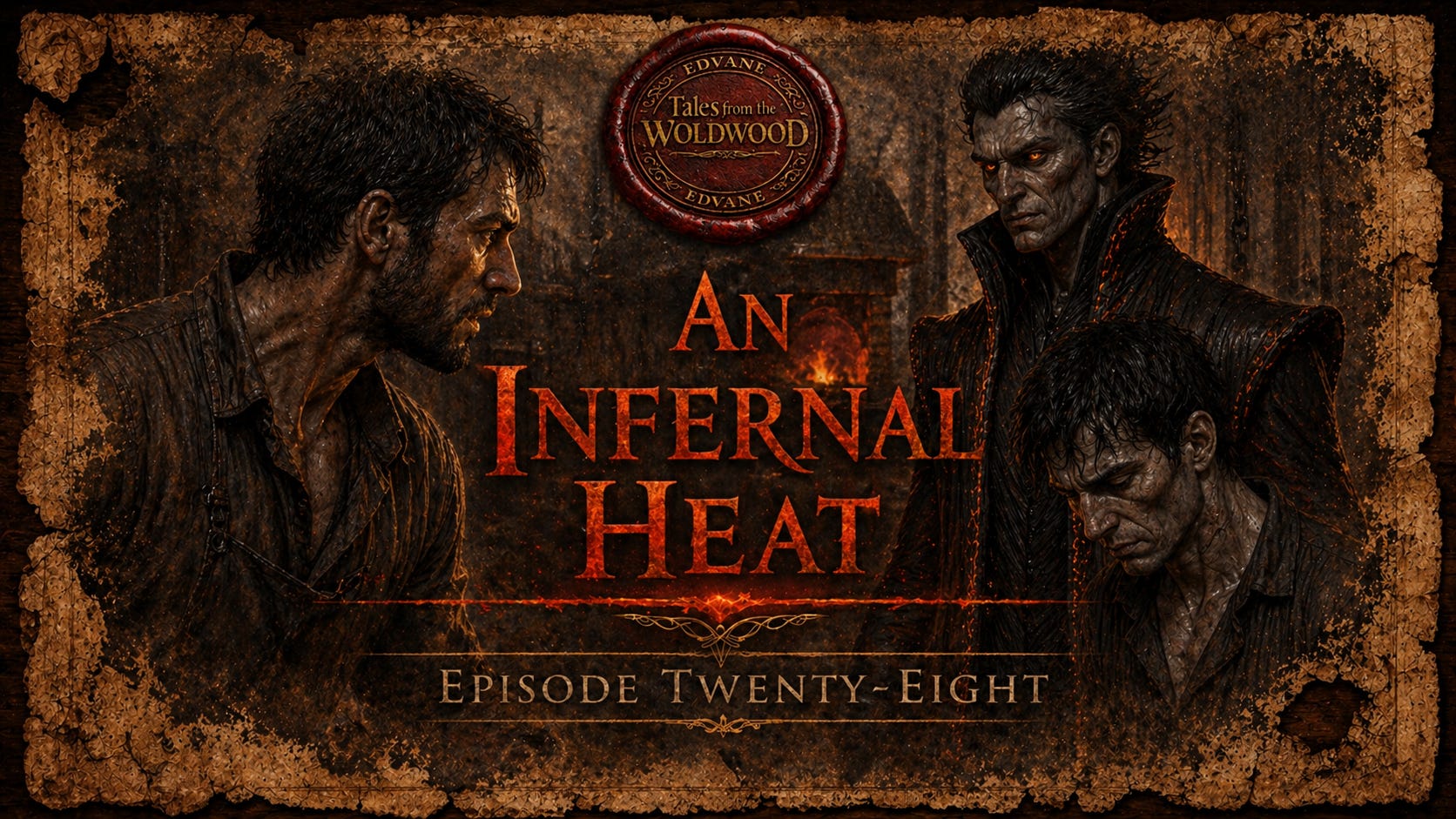
Today we visit Ironreach once more, where a craftsman has discovered how to make steel that never quite cools, and in doing so has created an opening he cannot close.
Hector Clay had always trusted heat more than talk. Men could say anything in a tavern and call it truth if enough cups were emptied, but fire had no interest in flattery. It took what you fed it, gave what it gave and punished carelessness. His forge sat in a soot-blackened lane not far from the harbour. On still days he could hear rigging tapping masts, and on rough days, the wind pushed brine into every crack.
That evening began ordinarily enough. Hector had a small order of dock knives to finish, nothing fancy, just good steel, the sort of work that kept him fed. He drew the first blank out, watched the colour, felt the metal soften under the hammer’s rhythm and then quenched it in the trough. Steam rose, hissed and faded, then on to the next. His fingertips brushed the first knife when he set it down, and he was immediately struck by the residual heat, despite having plunged it into the water. He told himself he’d misjudged the timing and quenched the second, set it down, and went back to the first. The warmth had not ebbed. It just persisted in the steel. He frowned at it and then resolved to do what he always did when something refused to behave. He tested it.
The next day, before the light had properly taken the streets, he was already at the anvil. Fig, his apprentice, arrived to find him there.
“You didn’t go home,” Fig said.
Hector ignored the remark. “Coal. And the thin stock.”
Fig fetched what was asked. He was young. Not a boy any more but not yet a man with his own place in the town, and he had learned that Hector’s silences were not openings. He went to the bellows, fed the forge, and settled into familiar tasks.
Hector forged another knife and quenched it. Warm. He forged a longer blade, quenched it, tempered it, even letting one cool in the open air to see if slowness changed anything. Still warm. Different methods, different rhythms, same result.
By midday Fig could not help himself. He reached for one of the finished blades, touched it, and snatched his hand back. “It’s like it remembers the fire.”
Hector held the knife up and turned it in the light. “Steel remembers a lot,” he said.
Fig’s brow furrowed. “That’s not what I mean.”
Hector set the blade down with care. “Neither do I, yet. Keep the bellows steady.”
He tried to keep his mind on the craft and wrote notes in charcoal on scraps of parchment. He watched grain and colour and listened for the way metal sang when it wanted to move. The blades were better than fine. It should have pleased him and stopped there. But a door opened in his mind, and a revealing thought came through.
This is what men pay for. What keeps them alive. It is what Ironreach needs.
He was not a greedy man by nature, and he had never chased coin, but the town had a way of wearing a man down. Captains and Dock foremen came at the end of the month looking for discounts, and traders smiled while they tried to strip value out of your work. Hector had swallowed a lot of that over the years and told himself it was how the world was. Now, as he held a warm blade that refused to cool, he felt the arrival of leverage.
The first customer to notice was a guard captain who brought a cracked sword and a sour face. Hector had planned to repair it, but instead he offered one of his new blades. The captain hefted it, tested the balance, ran a thumb along the edge and drew a thin line of blood. “How much?” Hector named a price that would once have made him anxious, but the captain did not argue. He nodded and said, “Make me two more.”
After that, the forge stopped feeling like a place where work happened and began to feel like a place where need piled up. Sailors wanted knives that wouldn’t fail in cold spray. A merchant wanted a matched set that he could show and boast about. Hector took their orders and told himself he was finally being paid what his hands were worth.
The forge never cooled properly after that. It wasn’t dramatic. There was no flaring or blue fire spitting. It simply refused the clean ending Hector expected. He banked the coals at night the way he always had, covered them with ash, closed the vents and did all he could to starve the flame. In the morning, the embers still breathed, and his anvil was warm to the touch even when the room around it was cold. Hector noticed but pretended not to, telling himself he was working harder and that the heat lingered because he’d fed the forge more. He told himself anything that would give him permission to keep striking metal, without admitting that the forge was learning a different kind of persistence.
Fig noticed too. He began to arrive with shadows under his eyes, and his hands shook sometimes when he held the tongs. Once, when Hector spoke harshly, Fig flinched and braced for a thump, which unsettled Hector because he had not been that sort of master.
One afternoon, Fig approached and questioned Hector. “Is it safe?”
Hector kept working. “It’s steel.”
“That’s not what I asked.”
Hector struck again, the hammer ringing. “Nothing’s happened.”
Fig’s voice tightened. “Nothing’s happened yet.”
Hector’s anger rose swiftly. He hated it when fear tried to wear the mask of good sense. “Do you know how many blades crack in a cold snap because men buy cheap? Do you know how many dockmen go to ground with fingers missing because their knife turned brittle at the wrong time? This is better work and better steel. That is all.” Fig just stared at the warm blades hanging on the rack and retreated into the heavy silence now hanging between them.
At night, Hector found he could not rest. He would lie in his narrow bed above the cooper’s shed and feel the cold in his bones. He would think of the steady warmth of the forge and feel an irresistible pull toward it. He began going back to it before dawn, and sometimes in the middle of the night, just to stand near the anvil and feel the air there. The warmth eased something in him and steadied his thoughts. It made the world feel simpler.
Then the first blade came back. A sailor arrived with a face grey as old ash and held out a knife Hector recognised as one of his earliest, still warm. “My brother had this,” he said.
Hector’s stomach turned a little. “What’s wrong with it?”
The sailor’s hand trembled. “Nothing is wrong with it.”
Hector frowned. “Then why bring it back?”
“He slept with it,” the sailor said. “Said the warmth helped his hands and helped him sleep easier. Then he started waking drenched, coughing like he’d swallowed smoke. He said it was just drink or fever. Then he started talking in his sleep. Not words, just… sounds and he got thin. One day he didn’t wake at all.”
Hector held the knife and felt the warmth sink into his palm. He tried to speak, to provide any explanation that would keep his world from cracking.
The sailor continued. “I don’t want it in my house.”
Hector could have told him to throw it into the sea and let the brine have it, or taken it and smashed it on the anvil until it was nothing but scraps. Astonishingly, he found himself saying, “I’ll buy it back.”
The sailor blinked, startled. “Buy it back?” Hector named a sum, and the sailor took it and left in a hurry. He stood alone with the returned blade and felt a sick satisfaction. He had reclaimed something valuable that had been foolishly misplaced.
Fig saw it when he came back in from sweeping the yard. His face went pale. “Why is that back?”
“It was returned,” Hector said.
“Returned because...”
“Because men are fools and they panic,” Hector cut in.
Fig stepped closer, eyes on the knife. “Hector, it’s still warm.”
“So are all of them.”
“You paid to get it back.” said Fig
“Get on with your work.”
Fig did not move. “Someone died.”
“Look, I can’t mend the world, Fig,” Hector said. “I can make steel.”
Fig pressed further. “You’re pretending you don’t know.”
“Work,” Hector said. “Or leave.”
Fig turned to the bellows and began to pump, and Hector went back to the anvil and struck more metal until his arms burned and his thoughts returned to his blades. He told himself he was doing what he had to. He told himself the orders were already paid, that he would stop after this batch or after the next, at least when he had enough coin to breathe. He never reached enough, though.
The changes in the forge continued to grow. Water left in a cup near the hearth steamed, though it never boiled. The air in the forge stayed warm even when the fire was at its lowest. Sometimes Hector observed a shimmering above clean blades which pulsed and vanished, but he just blinked hard and forced himself to look away.
Fig began to fail. He dropped a hammer and stared at it as if he’d forgotten what it was. He moved around slowly, his cheeks hollowed, and his eyes became vacant. Hector told himself Fig was weak, that he could not handle long hours, anything that excused not stopping. He couldn’t stop. He had coin now. Men were waiting for steel that no other forge in Ironreach could offer. He had become necessary.
The day the truth came, it was late, and Hector was finishing a long blade commissioned by a merchant who wanted a sword to hang above a hearth and speak of strength. Hector had charged him enough to make his hands tremble when he counted it. The blade drank the heat and moved willingly under his hammer, becoming what he asked. When he quenched it, the water hissed, and the blade came out warmer than any he’d felt before, and he smiled.
Behind him, the forge made an unusual sound that was not the usual crackle. The ember-glow at the forge mouth was deepening unnaturally into darkness and a deep chasm that did not belong there. Hector called out. “Fig?”
From that depth came a voice that was not Fig’s, nor that of any mortal. It spoke his name. “Hector Clay.”
Hector lifted the fresh blade and held it between himself and the dark. “Who’s there?”
The darkness moved, coalescing into a presence that gradually became more definite. It was tall, with angular features and too sure of itself. Hector saw a suggestion of a face, an impression of eyes and a mouth that seemed to smile without needing lips.
“Get out,” he said.
The thing drifted closer, growing increasingly clear. “You have been making doors, Hector,” it said.
Hector’s mind scrambled for an explanation. Was it technique? An accident? Some contamination in the coal, perhaps?. He clung to explanations the way a drowning man clings to driftwood. “I’ve been making blades,” he snapped.
“Blades,” it agreed, amused. “Warm thresholds. Hinges. Doors that can be opened.”
Hector’s stomach lurched. “I didn’t make...”
“You invited it,” it said. “You held heat where it should have died. You taught steel to keep the fire. You fed my hunger and called it craft.”
Hector’s hands shook, and he felt a horror so deep that it made him dizzy, because now he saw it clearly. He could see those blades were not tools or gifts. They were openings, patiently waiting for a will to turn them.
“Where is Fig?” he whispered.
The thing’s smile widened. “Here.”
Footsteps sounded from the back room. Fig emerged into the forge light, and Hector felt a momentary relief that died immediately. Fig’s face was slack. His eyes were open but too still and too deep. He moved like a puppet, pulled by strings rather than muscle.
“Hector,” Fig said, yet it was not Fig’s voice. It was layered with something different and evil. “It’s cold.”
Hector moved toward him. “Fig, stop. Get away from...” Fig lifted his head, and his cold eyes carried a depth that made Hector want to look away. The thing drifted beside Fig and rested a shadowy hand on his shoulder, at which Fig smiled.
“I am Trinuth,” the thing said, and the name felt as if it had been waiting in the forge bricks all along. “And you have been so generous, Hector.”
“I didn’t know,” Hector said, and the words were wasted.
Trinuth drifted closer still, his warmth pressing against Hector’s skin. “At first,” it agreed. “At first you found my warmth and wondered. Then you tested and saw it obey. Then you priced it.” Trinuth laughed out loud, not caring who heard. “Then you bought back the first warning and told yourself you were being practical. This boy begged, and you told him to work or leave. Do you hear how simple that is, Hector Clay? Do you hear how easily you chose?”
Hector wanted to deny it. He wanted to smash the anvil, drown the coals, shatter every blade, run into the night and never look back. He wanted, desperately, to be the man he had been before, but the blades were already out there. The orders already paid. The coin already counted. The doors already distributed.
“If you stop,” Trinuth continued, “you return to being small. A struggling smith in a salty town. A man who is bargained with, and who sleeps because he has nothing else. If you continue, you remain necessary, rich and,” Trinuth laughed again, “warm.”
What decency Hector had left in him rose one last time and tried to speak. This is wrong. This will ruin people. This will bring evil into good homes. But the greed that had been growing in him, fed by praise and coin and the forge’s steady reward, stepped forward and strangled the words before they could form.
He found himself asking, almost calmly, “What do you want?”
Trinuth’s smile widened with satisfaction. “Good. More doors,” it said. “More openings carried into the Marchlands by good hands. Carried into good houses by good men who believe you when you sell them strength. Let them keep their blades close, sleep beside them and dream.”
Hector’s stomach turned, but his hands did not lift to stop it. He thought of the merchant waiting, the next orders and the chest of coin upstairs. He told himself that stopping would not capture what had already been loosed. And beneath that, he felt something colder. He did not want to stop.

He looked at Fig, or what wore Fig, and said, “He can’t...” but the protest died halfway because Fig’s posture was steadier than it had been in weeks and his eyes were now bright. Fig’s mouth moved with a confidence Fig had never possessed.
“I can work,” Fig said, his voice still layered. “I can work all night.”
Trinuth’s hand tightened on Fig’s shoulder in an almost possessive gesture. “A vessel, Hector Clay,” Trinuth said, pleased with himself. “My vessel.” Trinuth drifted back toward the forge mouth, retreating into its proper place. “Send them out,” it barked. “Let the Marchlands carry what you make.”
Hector looked to the street beyond his door and the town beyond that, where decent people slept and believed evil to be held at bay by good men. He imagined his blades hung over doors, tucked under pillows, carried on belts, and he felt no urge to protect those people from all Trinuth threatened. He felt only the satisfaction of being the hand that made it possible.
He turned back to the anvil, fed the fire and took up his hammer. The forge’s warmth embraced him once more. Behind him, Fig stood with the warm blade in his hand, smiling with a borrowed mouth, while the darkness in the forge waited with patient hunger.
Hector Clay brought the hammer down, and he did not care who would pay for it.
So evil entered through usefulness, and when comfort replaces conscience and success is allowed to excuse consequence, the door does not need to be broken down. It is opened willingly, and often by good hands.
Listen on YouTube: