
An Eye For Detail
It is a temporary inconvenience...

Consider a man who has already solved the world. He knows its myths, limits, and rules. When he acquires something that changes how darkness works and barriers behave, he does not call it revelation. He calls it inconvenient.
The Black Bogs of Mock did not welcome feet. Such surfaces as formed there were a kind of consensus between water and rot. A truce that could be broken by one careless step. The reeds stood in loose ranks, bent and unbothered, and between them lay black water, releasing slow bubbles that broke with wet pops.
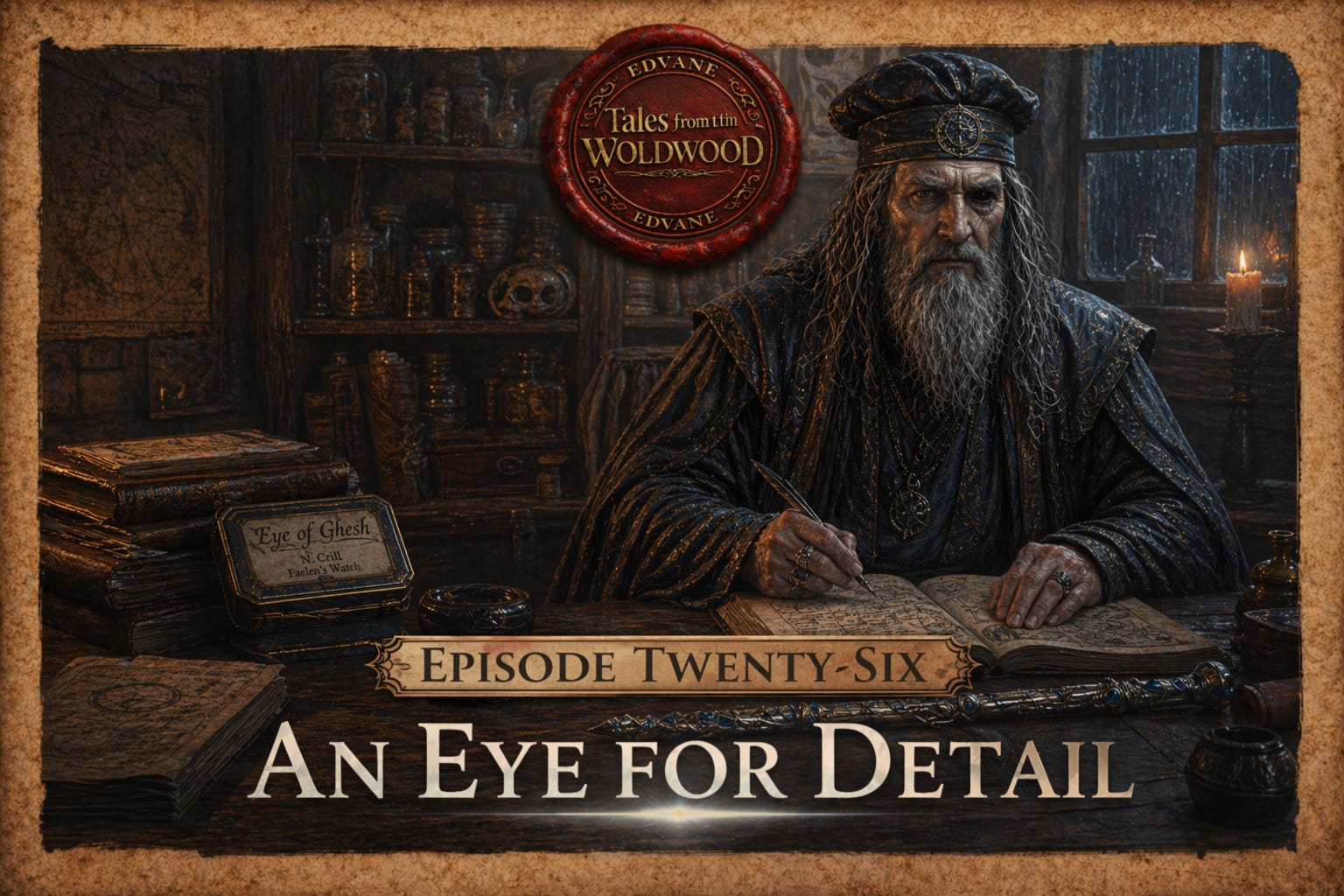
Nimus Crill moved through the bog, already knowing the cost, and now simply paying it. He carried his wand, Brinefold, in his right hand. It was long and thin, slightly translucent, its internal struts visible when exposed by the lightning, which that evening accompanied the thunder above him. Set into the pale structure were blue stones, and above the grip sat a raised, notched, circular ridge which kept his hand from sliding off. Nimus lifted the wand and looked around, letting rain run down his cheeks and under his collar. “Where are you, Ghesh?” he asked the air, hopefully.
The name had followed him for decades without ever producing proof. Boys had whispered it as a dare. Old women had spat it as a curse. Men who drank too hard and slept too close to water had claimed to see an eye rise in the black and watch them while they pissed. Nimus had listened to all of them, keeping the hard evidence and discarding the hysteria. He had come alone, not telling anyone at Faelen’s Watch why he was leaving or where he was going. As a Hidren Master, he had been teaching younger wizards not to drown themselves in their own cleverness and to respect the water and hydromancy. His was a reputation of harmless oddity that made his true interests easier to pursue, and he knew it.
Nimus reached a stretch where he observed a steady tapping on the surface of the bog. He stopped and looked down at the water, noticing the absence of small sounds and the lack of frogs or insects. Life was avoiding this patch. Then suddenly the water moved as something displaced its mass beneath the surface and began travelling toward him at speed. The reeds ahead of him trembled, pushed outward from below, and the water erupted.
Ghesh did not leap in the manner of a fish. It surged and rolled itself out of the bog, amphibian in the broad cruelty of its design, though no common bog-beast had ever carried such intent as this. Its skin was dark and shiny, striated with ridges that shone when the lightning flashed, and those ridges were not decoration either. They were channels where water entered and left. Its limbs unfolded, thick and jointed, ending in long splayed digits that sank into the mud and held like anchors in the liquid. Its head was wide, to accommodate its gaping mouth, but what mattered was the eye.
The left eye, set deeper than the right, was an empty, black disc. Ghesh turned that eye toward him. Nimus felt nothing mystical about it and raised Brinefold. The blue stones within it darkened. He did not throw a wave at Ghesh because the creature lived submerged and would likely resist it. He instructed it to set a current against the creature’s flank to pull it sideways into the softer mud where its own weight would become a struggle. The water moved as directed, but when it met Ghesh, it did not take hold, sliding along the creature’s skin and vanishing into those ridges. Ghesh did not stagger or even acknowledge the action as a threat.
Nimus felt briefly irritated and adjusted, shifting his command from force to disruption. The water around Ghesh changed texture, thickened and became a slurry of brine and grit drawn up from deep below. Brinefold’s stones caught the rain and turned it into strands that threaded the bog-water like veins. Ghesh charged at an angle, understanding where the ground would betray him. It used the reeds as cover, pushing through them with a wet hiss, and then it was out of them and close enough that Nimus could see the thin membrane over its nostrils open and close, drawing the bog-water in.
He swung Brinefold, and the rain fell harder in a narrow sheet between them. The sheet struck Ghesh’s face, and the creature recoiled, momentarily blinded by the impact. Nimus used that moment and called cold from the rain itself, commanding the water to strike and then shock. Ghesh’s mouth opened to expel water in a sudden purge that sprayed the air and broke the cold’s grip. Then it lunged and one webbed pad struck Nimus as he pivoted, pain searing across his ribs. The creature turned with him, bringing its head up slightly, and Nimus saw that the right eye was ordinary enough, but the darkened left eye remained unblinking. He had come for that.
He shifted his grip on Brinefold and drove its tip into the bog-water beside Ghesh’s forelimb. The wand vanished into the black for a moment, and when he pulled it up again, it brought with it a coil of water that behaved like rope. He snapped the coil around Ghesh’s limb, and for the first time the creature reacted with surprise as the coil held. It tried to yank at it, and mud flew, but though the coil creaked, it did not yield. Nimus used the coil like a leash and moved sideways, drawing Ghesh’s head with him.
“Look at me!” he shouted.
Ghesh’s mouth opened wider, and it snapped at the air where his hand passed, showing its rows of small, razor-sharp teeth. Nimus made a noise when he smelled the revolting odour of rotten meat and stagnant pools in that mouth. He drew his knife while still brandishing Brinefold in the other, and brought cold, hard against Ghesh’s head. The creature jerked and then shook. He saw its left eye roll slightly, the black disc exposed more fully, so he took the chance, stepped in and drove the knife. Ghesh convulsed, the brine coil snapped, and water exploded outward as the creature’s limb tore free of the binding and struck Nimus’s arm. He felt the bones in his hand ring with pain, but the knife remained in his grip because he refused to let go.
Ghesh twisted again, head bucking, and the eye came with that motion, the blade tearing it free with a wet sucking sound. The black disc flipped up, and he caught it in the same hand, momentarily holding it and watching Ghesh’s body shudder. The beast slid backward into the water, dragging itself into retreat. Nimus did not pursue or stand over it to ensure death. He had what he needed, and the bog was not a place for loitering. Ghesh’s right eye watched him as it sank, pale and blinking, and Nimus wondered if he had taken the wrong one. Possibly the black eye was not the key but the lure. Then the water closed, the reeds settled, and the only movement was rain. He wrapped the eye in cloth and sealed it in a tin, sliding that into the inner pocket of his coat.
Faelen’s Watch rose from the land around the tower at its heart. When Nimus returned, the gatekeeper saw him and lifted a hand in a weary greeting that carried no question. Nimus nodded in return and walked through without stopping.
His home was small and simple because he had never trusted comfort, though he did have means. He removed the tin from his coat and set it on the table with care. Then he removed the lid, unwrapped the cloth slowly, and exposed the eye. It lay there like a polished stone, holding its blackness. Nimus brought it close to his face and examined it, looking for veins, membranes, the ordinary signs that it had once belonged to something living. He found none. The eye’s surface was too smooth, and beneath it the blackness had an unusual depth.
He lifted Brinefold once more and held it near the eye, watching for reaction. The air around the eye dampened, and a fine film of condensation formed on the wand’s shaft. Nimus frowned, annoyed with the vagueness of this response.

“Interference,” he said, and set the wand down again, writing the word in his ledger
He placed the eye in a shallow bowl and set the bowl in the window where rain could reach it. The window did not open fully. It had been designed to admit air without inviting birds, but Nimus angled the bowl so droplets could fall into it, collected from the ledge by a small, wooden chute. He watched for a moment as rain hit the eye and beaded on its surface. The droplets did not slide away. They pooled, then suddenly vanished, absorbed without trace.
Nimus waited, and the day dimmed into evening. He set a candle on the table and struck flint, but he did not light it yet. He sat and watched the bowl. When enough rain had collected, the water in the bowl began to darken. The eye remained unchanged, still black, still smooth, still sitting in the bowl like a stone at the bottom of a well. The water above it eventually became an oily, black liquid. Nimus leaned in and smelled it. Nothing remarkable. He waited longer, but as night gathered, he realised he was out of ideas that did not lead back to the same place. He poured a small amount of the black liquid into a glass. It clung to the sides, and he held it up to the dim light, hoping for a glow but finding none.
He sighed, the sound of a collector confronting a specimen that refused to give up its habits. Then a thought occurred, and he spoke aloud to himself, “Don’t be foolish, Crill.”
Then he drank.
The taste was immediate and not merely unpleasant. It coated his tongue and then turned sharp, biting at the back of his throat. For a moment, he thought he would retch, but he swallowed again until the taste receded enough that he could breathe without tasting it. He stamped on the floor, cursing, “Nimus, never again. Never, never again. You dimwit!”
His left eye began to ache, and Nimus blinked, rubbed at his eyelid, and then stopped dead because the world was altered. The room did not darken, but the left side of his vision dulled until it was nothing. He closed his left eye and opened it again, but there was no return, and he sat very still so he might test what was true. He turned his head left and right, gauging what his right eye could cover. He walked to the door and touched the frame, then the wall, then the table again, confirming that his balance remained intact. It was only sight that had been altered, and only on one side. He went back to his ledger and wrote a single line that described the onset and the result, careful not to embellish it with fear
He remained in his quarters through the rest of that evening, trying to understand. He poured more rain into the bowl as the night deepened. The black liquid returned, and the eye remained unchanged. When he finally extinguished the candle and let the room fall into true darkness, something happened that he did not record immediately. His left eye opened onto the dark, and it did not see the way his right eye saw any longer. He stood slowly and walked to the door without touching the wall. His right eye saw nothing, but the left guided him. The darkness was a medium he could now read.
Nimus went to the door and opened it. The street beyond was unlit and should have been black and empty. But his left eye read the street’s length, the subtle curve where it bent and the shape of a bucket left against the wall. He walked down the street and made his way to the central yard of Faelen’s Watch. The yard should have been a void, yet in his left eye, it was full. He saw men standing under the eaves, smoking, their faces indistinct but their postures clear. He saw water running in channels along the stones.
A voice called his name. “Master Crill?”
Nimus turned his head. His right eye found nothing, but his left found the speaker easily, a younger wizard with a hood up.
“I thought you were away,” the young man said, stepping closer.
“Evidently I returned, young man,” Nimus replied.
The young wizard hesitated, then stepped closer still, peering at him and trying to discern what had changed.
“You look unwell,” the boy said.
“Far from it, I’m fine,” Nimus replied. He did not want the conversation.
The boy, emboldened by concern, leaned nearer. “Your eye…”
Nimus blinked. “It is a temporary inconvenience,” he said.
He carried on toward the tower, but its lower door was locked, which was usual. Only those with specific authority and countersigns were meant to enter after nightfall. Nimus had not used that door in years, mainly because he had his own passages and privileges, and he did not care for climbing the stairs. He approached anyway, stopping in front of the door. The lock clicked, and he reached out and lifted the latch. It moved, the door opening inward on silent hinges. Nimus looked into the stairwell beyond. He laughed in disbelief.
“Key,” he said and stepped inside.
He did not go far, climbing only a few steps, then stopping and going back down. He closed the door behind him, making sure the latch engaged. Then he stepped away and waited. The lock clicked again, returning to its locked state. He returned to his quarters and wrote in his ledger until the candle burned down. He wrote about the onset of blindness by day, the emergence of sight by night and the responsive locks.
In the morning, the left side of his vision was gone again. It did not return with light. It vanished as soon as dawn arrived. Daylight blindness, he wrote, and under it he added a line that acknowledged the inconvenience of it.
He kept Ghesh’s eye in rainwater. The black liquid formed reliably, but he never drank further to see whether excess would do more. But he did test the Eye’s function on other seals. Within Faelen’s Watch, there was a cistern chamber on the eastern side, warded and locked, its door marked with old runes. Nimus had assumed it held a security measure or an old mistake kept contained because no one wanted to deal with it. One evening, with darkness descended and his left eye awake, he walked to the warded door and stood before it. The runes did not flare, as he would have expected. They quieted, recognising a signature. The lock clicked, and the ward remained inert. Nimus reached out and opened the door, and air spilled from within, carrying the smell of stagnant water. The chamber beyond held a stone cistern filled to the brim. The water within it did not ripple from his entrance. It was still, too still, waiting. Then a shape rose, breaking the water with its rounded head, and eyes shining through the dark. It glared at him, and Nimus halted. His left eye read the cistern’s depth, the creature’s position, and the way the water held around it. His right eye saw only darkness. The creature did not speak. It just watched him, so he stepped back out. The creature did not follow. The lock clicked behind him, and the ward resumed. He wrote that night that access did not imply control, that the Eye behaved as a key to certain places and perhaps to certain recognitions.
A week later, a visitor arrived at Faelen’s Watch. The man wore a travel cloak and carried a satchel heavy with paper. He spoke with the mild arrogance of someone who believes knowledge belongs to them. He had come from the southern school at Elk Ridge, bringing notes and requests and a desire to compare methods. It was the only formal institution Faelen’s Watch co-operated with, and Nimus received him out of obligation and habit. They met in Nimus’s quarters because he did not care to walk far in daylight with his newly acquired loss of sight.
“You have an injury?” the visitor asked, unable to restrain his curiosity.
Nimus did not look up. “An alteration,” he replied.
The visitor leaned forward. “May I?”
“No,” Nimus said and continued writing.
“I have heard rumours,” the visitor said, choosing his tone carefully, “of odd practices among Hidren. Of water used as more than water. Of…” He hesitated, then smiled as if embarrassed by his own indulgence. “Forgive me. Tales. You know how tales grow.”
Nimus looked up. “Tales are often the only proof people bother to preserve,” Nimus said.
The visitor stared at Nimus’s left eye. “It does not look like a wound,” he murmured. “It looks like something set.”
Nimus was stoic. “Many things can be set,” he said, and went back to his ledger.
The visitor laughed, trying to make the moment lighter. “Some would say such a thing could only come from myth,” he said. “From the Black Bogs of Mock, perhaps?” He watched Nimus closely as he spoke. “Ghesh. They say its eye is black as pitch. They say it watches men in the dark, and they lose their way. Nonsense, of course. No one has ever found it. Myths serve to keep fools from drowning themselves.”
Nimus paused to consider his reply. He could have ended this man’s speculation with a sentence. But he saw no advantage in convincing a man whose scepticism was armour against any suspicion of him. “You are correct,” Nimus said eventually. “No one has ever found it.”
The man nodded, satisfied that he had flirted with a forbidden idea and returned safely to sensible shores. “Yes, I thought so,” he said and smiled with relief. “Still, your alteration is unusual.”
“It is a novelty,” Nimus said.
“A useful one?”
Nimus paused, then gave an honest answer. “Not especially.”
The visitor blinked. “Not especially,” he repeated, as if recalibrating. “Then why keep it?”
Nimus looked at him, and now there was disdain in his eyes. “Because it exists,” he said. “Because it persists. Because a collector does not discard something merely because it offends his preferences.”
The man finally got the message and turned to other matters. Methods, water discipline, schools and standards. Nimus answered where required and ignored all that bored him. When his visitor finally left, he departed with more questions than he had arrived with, and carried them away like an itch he could not yet scratch.
As the seasons turned, Nimus continued his tests until repetition became certainty. The Eye did not decay, soften or rot in the rainwater. He had documented it with quiet thoroughness, knowing his notes would outlive him. He concluded that the Eye of Ghesh was a key and something he did not need. After all, he had spent decades making doors open by other means. He kept Brinefold close through all of it, and he kept noticing the small incompatibility. Water behaved oddly around the Eye when the wand was near. Condensation gathered on it and then refused to settle. The effect was subtle enough that he could have dismissed it as imagination, but he wrote it down and circled it, then stopped thinking about it because he could not derive any further utility.
In the final year of his life, Nimus’s hands began to shake slightly in the mornings. He corrected his script by writing more slowly. His breathing became heavier when climbing stairs, and he avoided the tower, primarily because he no longer relished the climb. Age took him in the same unromantic way it takes most men, by curtailing his habits until only the essentials remain.
One night, Nimus sat at his table with the Eye in its bowl, and Brinefold laid beside it. He stared at the Eye and tried, for perhaps the first time, to imagine why anyone else might want it. He thought of younger wizards who feared darkness, who stumbled in it, who burned lamps and torches and announced themselves to every watching thing. He thought also of warded doors that resisted them because they did not carry the right permissions. Then he shrugged, because he was tired, and because imagining other lives had never been his strength. He had collected knowledge and assumed it would speak for itself when needed. He believed that was enough. It had always been enough for him.
“A spell,” he said and wrote it, the word holding a hint of dismissal. “A condition. A key.” He paused, then added, “Not very useful.”
He placed it back in its tin and sealed it. He labelled the tin and concluded the ledger entry, noting origin, method of activation, effect, cost, and known interactions. He noted the necessity of rainwater, the black liquid, ingestion and the consistent loss of daylight vision alongside the consistent return of dark sight. He noted the responsive locks, the tower door, the warded cistern’s opening and the creature’s attention, and lastly he noted the Eye’s lack of decay. Then he stood and walked to the cabinet where he stored specimens that were no longer in active rotation. He opened it with his own key, slid the tin vial into a space between two jars and closed the cabinet. He did not hide or ward it. Nor did he protect it beyond the ordinary measures he took with all of his collected work. He assumed that those who came after him would read his notes if they needed to understand. By the time morning came, he had already moved on to other items, other liquids. and other small curiosities. His mind had always been full. It did not linger.
Nimus Crill died in his sleep not long after. His house was cleared by men who did not understand half of what they handled, although they moved Brinefold with reverence and placed it in the care of the Hidren council, where such tools were preserved or kept until claimed. They packed his books and his papers into crates for the archive. They opened his cabinet and read labels without comprehension, setting aside what seemed interesting. The tin survived their initial scrutiny. His ledger survived intact because Nimus had written it in a durable ink and had kept it away from fire. It sat in the Watch archive, a quiet volume among many, until hands long after his death found the name Ghesh and paused.
And the Eye remained in its tin, unchanged by time, waiting without intention, a key that did not care what doors it might one day be asked to open.
Nimus Crill forgot that magical power does not always look important, and knowledge does not warn you when you have misunderstood it. And we learned that some things are lost because the wrong person found them first and decided they were not especially useful.
Tales from the Woldwood is a free 40-story descent into the Marchlands. The forests, ruins, people, monsters, bargains, and histories that shape the world before the first novel arrives
Listen on YouTube: