An Elder Law
There are bottoms, and there are slopes...

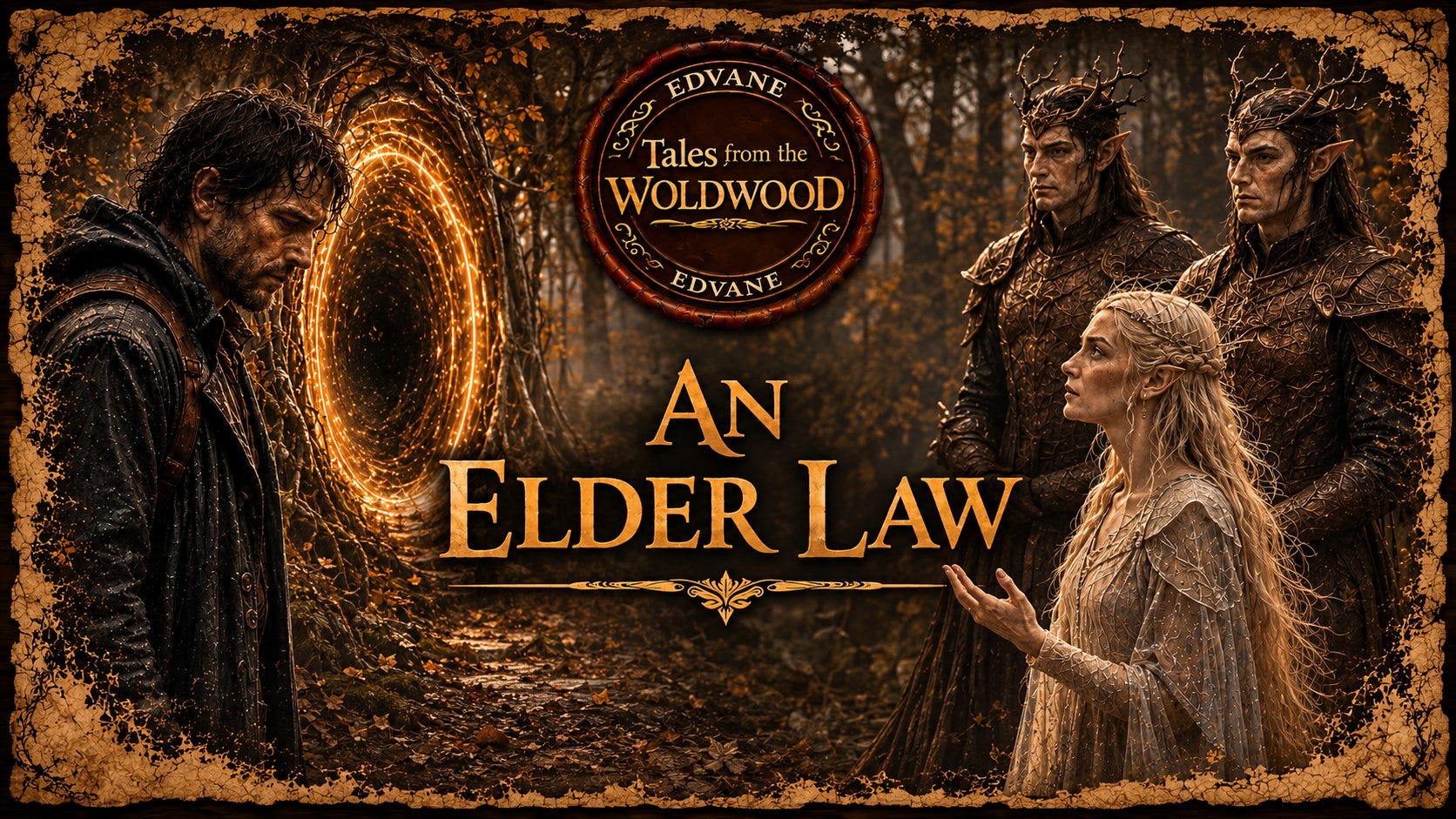
A traveller arrives in the fae lands of Serafall, driven by rain that will not stop. He finds a land of ancient beauty and elder laws, where names cast shadows, and the past is not forgiven simply because it is regretted.
The rain had been needling him since mid-afternoon with a petty insistence that soaked through cloth and patience alike. It came down relentlessly, driven sideways by wind that found every hole in his coat. Feritt Nash had walked with his head bowed, collar up, and boots dragging through the mud into early evening. The Marchlands gave nothing freely, and even the road here seemed less than promising. Just a line of darker ground that could vanish into scrub if you stopped paying attention.
Nash told himself he was only looking for shelter, a place to sit down and wait for the worst of it to pass. He told himself that because it was easier than dealing with the slow, grinding probability that the rain was no different from everything else now. A pressure he could not talk his way out of and a discomfort that would not be bargained with. He took shelter in a neglected coppice, sitting against a tree. Behind him was a low ridge, and at its base, half concealed by a curtain of hanging ivy, there was a mouth of darkness. It was not a proper cave, not the sort you would mark on a map or tell stories about in a tavern. It was an opening where the ground had caved and held the shape. He went to investigate, pushing aside the ivy with his forearm, ducking down and stepping in. The air inside was colder but still. The sound of the rain dulled there, and he saw that the cave went back further than he expected, the ceiling lowering in uneven shelves and the floor sloping down to a hollow where water had pooled. Nash picked his way to a patch that seemed less wet than the rest, set his pack down, and sat with his back against the wall. For a while he did nothing but listen. A drip somewhere near the back. The far-off murmur of wind. The steady rise and fall of his own breathing.
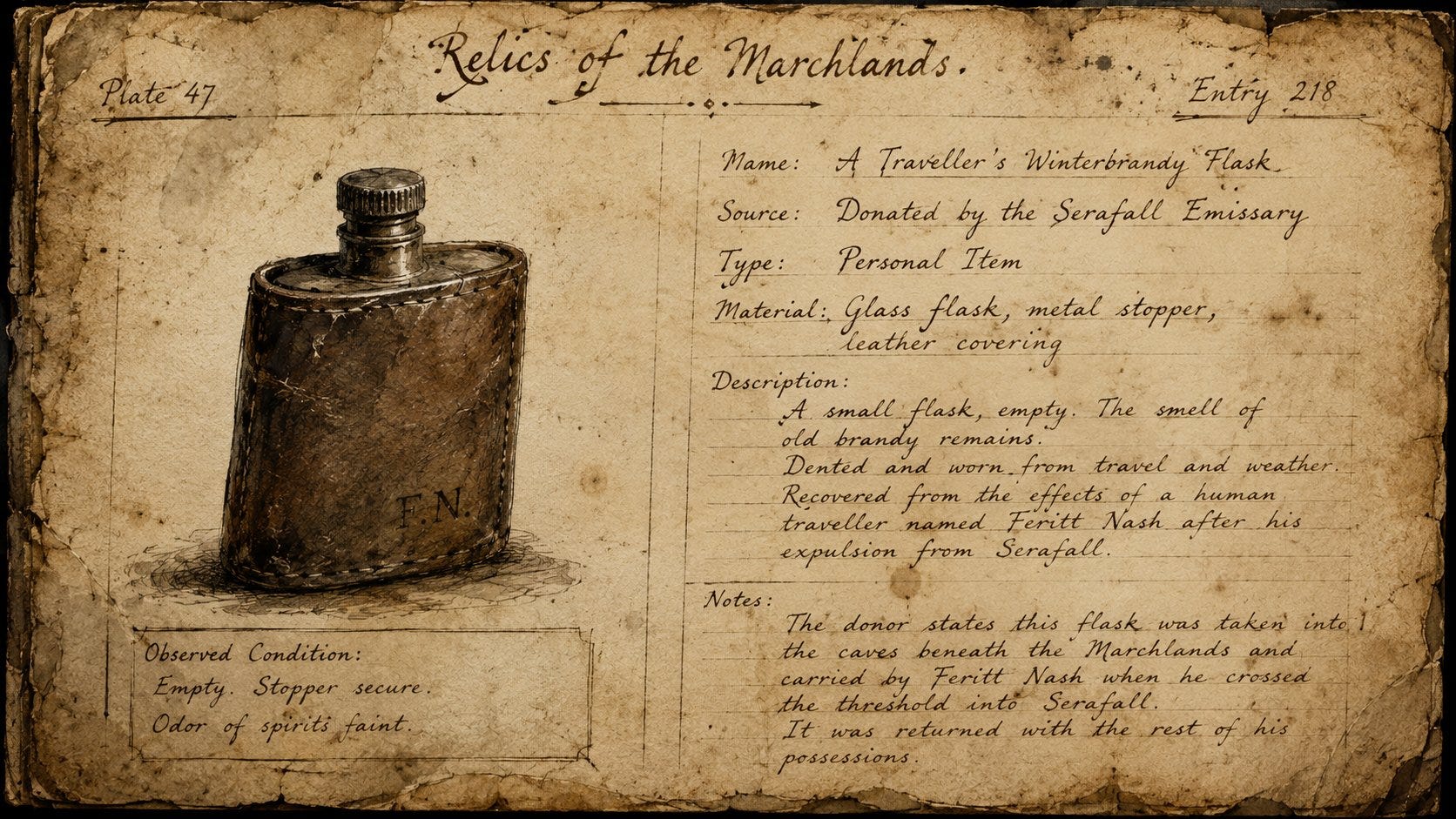
He had lived most of his life in rooms where noise proved you were not alone. Inns, gambling dens, brothels and the back parlours of merchants’ halls where men smiled too widely while counting crowns. Silence had always meant either wealth or danger. Here it meant neither. It meant the Marchlands did not care for him, or his story. He reached into his pack and drew out a small flask. There was not much winterbrandy left in it, but he drank anyway because the burn gave him something different to focus on besides the wet. When the flask was emptied, he put it away. Not that saving it mattered for anything other than a drip more in a desperate moment. He closed his eyes and told himself he would sleep for a while, then push on. Sleep came and dragged him down.
When he woke, he did not know at first how much time had passed. The cold had penetrated deeper, and his joints ached from his position. He opened his eyes and saw only dark and, for a moment, felt disoriented. Then he noticed something to the rear of the cave. A glow. It was steady and soft, a light that seemed to come from nowhere and yet filled the space with radiant, living colour. Blue. But not the blue of the sky or the sea. It was richer, layered with gold at its edges. Nash sat up and rubbed his face, dragged his fingers through his hair, and stared more.
In Lenth, there were stories told by old merchants to apprentices about caves like this. They were about doors that appeared only when you were desperate enough to ignore sense. There were stories about the fae, too, though Lenth people spoke of them with a careful humour. Nash had laughed at those stories as he had laughed at most things in the past.
The glow drew his eyes, and he moved deeper into the cave, which eventually opened into a small chamber where the ceiling rose higher. The glow was stronger there, filling the air with motes that drifted in the cool air. At the far side of the chamber, set into the stone as neatly as a fitted door-frame, there was an oval of light, and within that oval, there was a forest. Nash stood and looked closer. The forest beyond was lit by a kind of perpetual dusk, and its trees rose close together, hung with pale blossoms that shed a slow fall of petals like snow. There were sounds, too. A distant chiming and another sound that might have been voices or possibly the wind moving through leaves. He stepped into it without really thinking, and it was like walking into mist. He expected cold stone underfoot, but instead his boots met springier ground, soft with fallen petals. Another step and the cave behind him vanished, although the portal remained, an oval of green-gold light with the cave beyond it black and empty.
Nash moved forward. Each step carried him deeper into the woods, and the sensory richness pressed closer. There were creatures too, though he did not see them at first. A flash of white fur between roots. Something with wings, eyes that watched from the lower branches, reflecting light in colours that did not belong to any beast he knew of. Beauty here was unapologetic, complete and indifferent to whether you understood it or not. Nash’s first instinct was to smile. His second was to check his pockets.
The path beneath his feet was a petal-covered track. He followed it because paths were what he knew. He had always been good at following what other people had laid down, then stepping off it at the moment it served him. After a while, he saw the first sign of craft in a stone arch set across the path, tall enough that he could walk beneath without ducking. It was carved with vines so intricate they seemed to move when he tried to focus. The arch bore no gate. It marked a threshold, beyond which the trees opened into a wider glade. In the centre of the glade there was a standing pool, perfectly circular, its surface so still it looked like polished black glass. Around it, set in a ring, were upright stones etched with symbols and beyond the pool, blocking the continuation of the path, were two figures.
They stood side by side, not speaking, slim and tall. Their armour was fitted, lacquered, and engraved with a pattern, expensive-looking. In Lenth, men would polish metal to a shine, but these plates held a muted sheen that drank the light. Each wore a helm crowned with antlers that rose and branched in elegant arcs, too fine to be real bone and yet too organic to be mere craft. Their faces were visible beneath, pale and smooth, their eyes dark. Beautiful was the only word Nash had for them, wrong as that felt to him. One of them lifted a hand. The gesture was small, but it stopped Nash in his tracks, and he came to a halt. He felt suddenly absurd in his wet coat and travel-stained boots, with his hair tangled and his unshaven face.
The guard on the left spoke first. His voice was almost musical, but nothing was welcoming in it. “Name?”
Nash smiled, just enough. “Feritt.”
The other guard’s eyes held him. “And the name that holds you?”
Nash’s smile left his mouth. In Lenth, that would have meant family. House. Merchant guild. It would have meant a ledger line and a seal. Here it sounded like something deeper.
“I’m… just Feritt,” he said again.
The first guard’s antlered helm slipped slightly. “You are received at the threshold. Who vouches for you?”
No one had vouched for Nash in years. Once, men had offered him introductions as a matter of course. Once, doors had opened because his father’s name was known and his mother’s cousins sat on councils and signed trade charters. His family’s seal had been pressed into wax and accepted without question, but he had traded all that away one coin at a time.
“I’m not here to cause trouble,” he said. “I came through… I found a cave. I didn’t know what it was. It was raining on the road. I saw the light and... ”
“Who vouches for you?” the second guard repeated.
Nash felt frustration and fear because he had clearly walked into something he did not understand, and now it demanded the one thing he could not offer. Namely, a witness. He tried a different angle, the one he always used when the direct path failed. “Maybe you can tell me where I am,” he said. “Then I can explain myself properly?”
The first guard did not waver. “Serafall.”
He had heard of Serafall in songs half-drunk men sang by Lenth fires, the kind of old verse nobody knew the origins of. He had heard it spoken as a threat by women who smiled while they took your money. He had heard it in the murmured words of sailors who swore they’d seen lights in fog and come back missing hours.
“Serafall. I’ve heard of it,” he said.
The second guard was stoic. “That is not vouching.”
Nash could have tried to bluff. He could have invented a name, said a lord or a ruling mystic or some Marchlands monk had sent him. But the way they looked at him made the idea feel childish. It was not that they would catch him. It was that a lie here would not even rise into the air.
Still, habit drove him. “A man named...” he began, then paused, searching for something plausible. “...a man in a town. He told me there were ways… he said there were places in caves. I thought he was mad. I didn’t take it seriously.”
The first guard frowned. “A man. In a town.”
Nash spread his hands. “I don’t remember his name.”
The second guard’s voice turned colder, stripped of patience. “You evidently remember what benefits you, Mister Feritt.”
The words hit like a slap because they were true. Nash felt the lie crumble before it had even emerged properly. “I’m from Lenth,” he said. “From a good family. Or I was. I…” He hesitated. The shame of it, the fact of it, burned. “I lost everything. I can’t go back.”
The first guard’s expression did not change. “The name that holds you.”
Nash shut his eyes briefly, then opened them. “My family is...” He caught himself. Even now, even with nothing left, he felt a protective instinct around the name. He did not want it dragged into this place and spoken aloud by strangers. He did not want Serafall to know it.
The second guard watched his hesitation. “You cannot even speak it.”
“I can,” he snapped. “I won’t. It’s… it’s not for this.”
The air in the glade felt suddenly charged with attention, and a third presence made itself known. Something small drifted into the glade, moving between the stones with a lightness as though being carried by the air. At first Nash thought it might be a bird or a strange insect, but then it became clearer. Judge Preena was no higher than Nash’s waist. She was a sylph. Her limbs were slim. She wore a cloak of pale, translucent fabric that hung from her like folded wings, shifting through colours under the light. Her hair was a soft cloud of white-gold that floated slightly around her head. Her face was delicate, but her eyes were not. They were clear and old, and when she looked at Nash it felt as though she had already read him and was only waiting to see whether he would pretend otherwise.
The guards spoke together, “Judge Preena.”
She nodded and greeted them, “Daraen, Musto.”
She came to a stop between Daraen and Musto and spoke. “Received at the portal?” Preena said, her voice high but steady, carrying without effort. “An unsponsored arrival I see.”
Nash wanted to laugh at the absurdity of being judged by a small creature in a cloak. “I didn’t mean to intrude, madam,” he said.
Preena looked at him. “Meaning is not admission.”
“If I can speak to someone,” Nash said, “someone who understands...”
“It is clear to me that you have made a living by understanding what people want to hear.”
Nash had a sudden and visceral sensation of being seen without skin. “I’m not lying,” he said.
“You are,” Preena replied, “and you are also not.”
Nash frowned. “What does that mean?”
Preena looked past him toward the portal. “You speak truth about what you were. You lie about what you are. You do not lie because you are wicked. You lie because you are hungry.”
Nash’s cheeks flushed. “Everyone’s hungry.”
Preena’s smile held no warmth. “Not as you are.”
He felt angry. “You don’t know me.”
“I do,” Preena said. “Your scent carries it. Your steps carry it. The pattern of your eyes carries it.”
“I’m Feritt. I told you. I’m from Lenth. I had...” Nash stopped. Saying it out loud was a little too much. “I had a life,” he finished.
Preena watched him. “And you spent it.”
“I… I made mistakes.”
“You made a practice,” Preena replied.
The words landed with a finality that made his stomach twist. Nash searched for something, anything, that might turn this. A bargain. An appeal. A story with a better ending.
“What is this place?” he asked, and for the first time he exhibited some honest awe. “Why does it matter if I have… someone to vouch?”
Preena turned and looked over the glade, the pool and the carved stones. “Serafall is not a market,” she said. “It is not a road or a refuge. Serafall holds myth and tradition. Vows that do not break simply because the body grows tired.”
“I’m not asking to take anything,” he said. “I’m not a thief.”
Musto’s voice cut in, smooth as before. “You have lived by taking.”
“I’ve lived by surviving.” Nash snapped.
Daraen then spoke and showed the first hint of contempt Nash had heard. “You have lived by feeding on the misfortunes of others.”
Nash knew he was found out. “You don’t know what it’s like. When you’ve lost everything...”
“You lost what was given to you.” Preena cut in.
The distinction was merciless. Nash felt it strike deep, because he had spent years pretending his ruin was a storm that happened to him, rather than a slow choice he made each night. He tried another lie anyway. “If you let me in,” he said, “I can work. I can serve. I can... ”
Preena’s hand lifted, silencing him without touching. “You can perform,” she said. “You can flatter. You can bend. You can promise. You can weep when it profits you.”
“That’s not fair,” Nash replied
“We are not obliged to be fair, Mr Feritt.”
The words hung in the air, and Nash felt his eyes sting with the irritation of being trapped in a truth he could not reframe. He stared at the pool, his reflection barely visible in its dark surface. He looked older than he remembered. The rain had washed the last polish from him. He looked like a man who slept in caves.
He forced his voice to be steady. “Tell me what you want, then,” he said. “If you judge me, tell me what measure you use.”
Preena looked at him for a long time. “You measure as a man who had a name and pawned it for a night’s noise. You cannot even carry your own origin into the light,” she said. “You keep it firmly beneath your shirt.”
Nash’s hands shook because she was right. He still loved them enough to protect them from himself.
“I can change,” he said, and his voice cracked. “If that’s what you want. I can go back. I can...”
“You will not change,” Preena replied. The certainty in her voice was worse than any insult.
“How do you know?”
Preena’s eyes were very clear. “Because you have been given chances and you have used them to continue.”
“So that’s it,” he said. “You judge me and turn me away. Is that all Serafall does? Keeps itself pure.”
Musto’s voice came again, quiet and precise. “Serafall keeps what it is.”
Nash laughed. “And what am I, then? Dirt on your threshold.”
“You are ash that pretends it is soil.”
He tried one last time. “Let me in,” he pleaded. “Just for a day. Just to see. I won’t touch anything. I won’t take anything. I’ll be gone.”
“If you were allowed beyond this threshold,” Preena said, “you would not take. You would be taken.”
Nash was confused. “What does that mean?”
Preena gestured, a small motion toward the woods beyond the glade, where the path continued into deeper shadow between the trees. “Serafall is not a lesson,” she said. “It is an inheritance. You would become a warning. A caution. A tale told to keep children from wasting their lives.”
Nash imagined himself there, stuck and remembered only as a moral. The thought made him feel sick with a kind of panic.“I don’t want that,” he said.
“No,” she agreed. “You want what you always want. You want to be saved without being changed.”
Rainwater dripped from Nash’s hair onto the petal-strewn earth. He realised now that he had not once asked what Serafall required because he assumed that the requirements were negotiable. He looked at Daraen and Musto, but their faces were unreadable. They were not enjoying this encounter.
“So what happens now?” he said.
Preena stepped back. “Now you return,” she said. “You will speak your name as you have spoken it here. You will walk out as you walked in, and the threshold will close behind you and will not open for you again unless you are vouched for.”
Nash felt only resentment. “And if I find someone to vouch?”
“Then you will have already changed,” Preena replied.
“Fine,” he said, and his voice was rough. “Send me back.”
Daraen moved first, stepping around him, and Musto mirrored him on the other side. They did not touch Nash, but their proximity was enough to guide him. They turned, and Nash followed, because there was nowhere else to go.
They reached the place where the portal stood between the trees, its light spilling onto the ground. Nash stopped just short of it and looked back once, because part of him still wanted to steal a last sight, to carry proof that he had seen something no one in the taverns would believe.
Judge Preena had followed and stood a little back from them, and Nash caught sight of her. “Is that it, then?” he said. “I go back to the mud and the rain and the rest of my life?”
“Yes,” said the Judge, unmoved.
He laughed again. “You know,” he said, “I used to think I’d hit bottom. That there was a lowest point and then you climbed out or died.”
“There are bottoms,” Preena said. “And there are slopes, Feritt Nash.”
Nash felt something inside him sink. She knew his name all along, and her simple words carried more cruelty than any elaborate judgement she could make.
He stepped forward into the light and stumbled, catching himself on the wall. The cold was immediate, biting through his damp coat. The smell of earth returned, and the glow behind him shrank. The portal stayed for a moment, the forest beyond visible like a painting. Daraen and Musto stood at its edge, and Preena was a pale wisp behind them. Then the portal’s light dimmed, and the forest receded. The oval closed like an eye, leaving only stone and darkness.
He stepped over his pack and out into the Marchlands again. The wind and rain hit him in the face like a reprimand. The world was the same grey slurry of mud, scrub and distant, low hills. Nothing had changed. He walked on because stopping meant admitting that he had been judged by something that did not lie, and it had found no upward curve in him. He had always thought ruin came with drama, a final hand closing on your shoulder or a cliff edge you could point to and say, there, that was when it happened. But Judge Preena’s words followed him out into the rain.
There are bottoms, and there are slopes.
Nash trudged on, rain soaking him anew. The Marchlands took him back, and he felt the bitterness return and sink deep into him. It wasn’t the fiery bitterness of a man who still believed in reversal. It was the dull, heavy bitterness of a man who had been told, by a judge small enough to fit beneath his arm, that the worst of it was not yet behind him.
He found the road again and kept to it because at least it went somewhere. As the day bled toward another wet evening, he caught himself glancing at every dark hollow in the rock, every tangle of ivy, every cave mouth, now with a spiteful fear that the portal might open again and offer him the same refusal, over and over, to make sure he understood. But it did not.
Nash walked until his legs were lead and his boots squelched with each step. He thought of Lenth, its clean cobbled streets and warm lamps behind shuttered windows, of the way his mother used to straighten his collar without asking whether he wanted it. He thought of his father’s hands stained with ink from the ledger work, the seal pressed into wax, the simple fact of belonging. But he never spoke their names out loud. He kept them under his shirt, even now, even as the rain washed the world into the same grey stain. When darkness finally fell, there was no glow at the rear of any cave. There was only wet stone and the continued descent of the weather. Nash lay down under a hedge and listened to the rain on the leaves above him. He stared into the dark, and in that simple, miserable moment he understood the judgement he had been given more clearly than any spoken sentence.
Serafall had not thrown him out to punish him. It had turned him away because it saw what he could not resist becoming if it let him in, and whatever that was, it was not worth preserving. Nash closed his eyes against the rain and felt the slope beneath him, endless and already familiar.
Nash discovered that some places do not exist to redeem what we have wasted. They exist to remind us that loss caused by choice is not the same as loss endured for those who have already spent their own name.
Tales from the Woldwood is a free 40-story descent into the Marchlands. The forests, ruins, people, monsters, bargains, and histories that shape the world before the first novel arrives